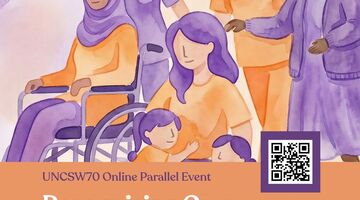
at CSW70 Global Coalition Calls for Care to Be Recognised as a Human Right Worldwide
This online event builds global momentum around the 2025 Advisory Opinion from the Inter-American Court of Human Rights, which recognised care as an autonomous, standalone human right, encompassing the right to give care, receive care, and self-care, while centering care workers’ rights and linking care to broader human rights, dignity, equality, and non-discrimination.

Comms
Co-organised by PSI, ILAW, ActionAid, FEMNET, DAWN, GI-ESCR, OXFAM, Womankind, Care International, GATJ, CESR, and TNJ during CSW70 (March 2026), the event featured a comprehensive global review of care policies across Europe, Africa, Asia, and North America.
Speakers highlighted privatisation trends, the impacts of austerity, and fiscal barriers, while calling for united action to reclaim care as a public good and a gender-transformative priority.
The event aimed to strengthen advocacy for recognising care as a human right within national legislation worldwide, extending beyond Latin America and the Caribbean.
Opening Remarks: The Role of PSI
Daniel Bertossa, PSI General Secretary, emphasised that PSI represents the voice of all care workers around the world, including those who work in the public system, the private system, and not-for-profit and community facilities, at national, local, and home-based levels. "We're the workers who provide these care services worldwide, and we're also the workers who are fighting back at the moment against attacks on democracy and workers' rights."
He recalled the 2021 Care Manifesto - Rebuilding the Social Organisation of Care - as the moment PSI and allies pushed beyond technocratic "care economy" talk and set out a sharper, rights-based agenda. "We need to recognise care as a human right; redistribute the care burden from families to public services; reclaim the fundamental public role of the state; [and] reward public service care workers with decent work and ensure they have representation through their independent trade unions. We were bold in shifting the narrative away from the notion of a care economy and towards rebuilding the social organisation of care."
Bertossa warned that this shift has provoked backlash from corporate actors trying to commodify care and closed by insisting the next step is unity and boldness -making sure profit never trumps rights, and taking the care-as-a-right debate beyond the Inter-American system on the road to CSW 2028. “We must ensure that profit never undermines rights. Access to care must not depend on the ability to pay. We must find ways to take the debate beyond the countries in which the Inter-American Court has jurisdiction.”
Panel 1: Care as a Human Right - Where We Stand Today
Georgia Montague Nelson (Global Labour Institute) shared a cross-regional scan of care laws and policies, showing that care systems still depend heavily on unpaid care work (mainly by women) while privatisation and marketization are expanding, often creating unequal access, weaker quality control, and more precarious work for care workers.
Jeff Vogt (iLaw Network) responded with legal pathways after the Inter-American Court’s advisory opinion, emphasising that it treats care as an enforceable right and includes specific protections for care workers across paid/unpaid and formal/informal contexts, including fair remuneration, safe conditions, reasonable hours and rest, and freedom of association and collective bargaining, alongside protections so unpaid caregiving does not undermine caregivers’ rights.
Panel 2: Feminist Political Economy Perspectives
Mahinour Elbadraoui (Center for Economic and Social Rights) argued that debt, austerity, and privatisation—shaped by IMF/World Bank policy frameworks—constrain governments’ ability to build universal public care systems, and highlighted strategies such as progressive taxation, regulating private provision, and using maximum available resources under human rights obligations.
Nicole Maloba (African Women’s Development and Communication Network) grounded financing care as a state obligation in African and global rights frameworks (including the Maputo Protocol), calling for public, gender-responsive funding; decent work and protection for formal and informal care workers; gender impact assessments in fiscal policy; action on illicit financial flows; and debt solutions so budgets can sustain care systems.
Neelandjana Mukia (Oxfam International) reflected on movement strategy, noting recent norm-setting wins (including the Inter-American Court opinion) while warning against co-option and financialisation of “care economy” agendas, and calling for broader alliances and coordinated advocacy on tax, debt, labor rights, and public-first public services to turn recognition into enforceable policy and budgets.
Strategic Discussion and Closing
Camila Barreto from GI-ESCR moderated the closing discussion emphasising diversity of analysis: policies across regions, legal/human rights aspects, structural financing challenges.
Juneia Batista, CUT, Brazil, defended what has been accomplished so far by PSI Unions, social movements and feminist movements to advance towards a more just, democratic world defending life, equality, future of societies and public services. She underlined the need to continue defending care through good services, good conditions for workers, recognising care as a job and not a privilege. "The Global South is suffering but will continue struggle", concluded Batista.
Margarita López, SINCUAVALLE, Colombia stressed that care is a fundamental pillar for gender justice and equality. Without care, there can be no equality or justice, and without justice for women, there can be no dignity or democracy. Care cannot be a human right if it is treated as a commodity. This requires strong financing, robust public services and systems, and institutions that connect care provision to enforceable legal and judicial pathways. For unions, the challenge is to turn the Inter-American Court’s recognition into practice as a global imperative, grounded in integrated models that guarantee support across financial, political, social, legal, and psychosocial dimensions.
read more
This parallel event to UNCSW70 organised by PSI, aims to build global momentum from the jurisprudence of the Inter-American Court of Human Rights to strengthen advocacy for recognising care as a human right within national legislation worldwide.