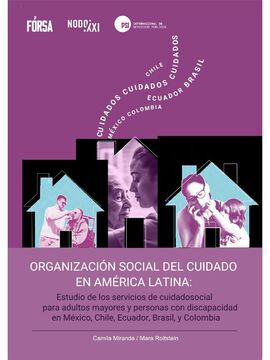
Who provides care in Latin America? A new PSI study analyses the role of the state, families and the market
Download pdf
Public Services International (PSI), in collaboration with the Nodo XXI Foundation, presents the study “The social organisation of care in Latin America: A Study of Social Care Services for Older People and People with Disabilities in Mexico, Chile, Ecuador, Brazil and Colombia”, a research project carried out as part of the FORSA project “The Social Organisation of Care and the Organisation of Workers in the Sector in Latin America”. This initiative forms part of PSI’s commitment to strengthening its regional leadership on care issues and promoting more visible and organised representation of workers in the sector.
The study analyses the situations in five Latin American countries — Mexico, Chile, Ecuador, Brazil and Colombia — identifying the main actors involved in the provision of care and examining the relative weight of public, private, family and community provision. It also addresses the working conditions of care workers and the challenges faced by governments in moving towards fairer and more universal systems.
The research confirms a reality shared across the region: care continues to fall mainly on families and, within them, on women, whilst public services remain inadequate and the private sector expands its presence, often without the necessary regulation. Added to this is the precarious nature of care work and the deep inequalities generated by this social organisation.
However, the report also identifies progress and innovative practices that point to a possible way forward. The processes of establishing National Care Systems and the growing recognition of care as a right represent a historic opportunity to build more democratic, equal and sustainable societies.
For the ISP, this study constitutes a strategic tool for trade union advocacy. In a context marked by an ageing population, the care crisis and growing pressures to commercialise these services, it is essential to defend the role of the state, strengthen public services, promote decent work in the sector and move towards a social organisation of care based on human rights and gender equality.
This publication aims to provide evidence for public and trade union debate, contributing to the discussions currently taking place in various Latin American countries on the creation and consolidation of National Care Systems, as well as on the recognition of care as a human right and a fundamental pillar for the sustainability of life.
We invite our affiliated organisations, trade union leaders, public sector workers, and all those interested in building fairer care systems to familiarise themselves with this publication and join this debate, which will be decisive for the future of our countries.