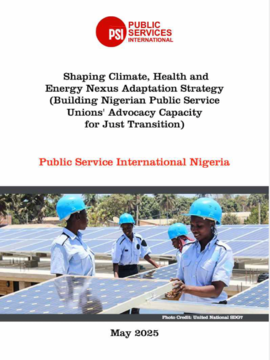
Shaping Climate, Health and Energy Nexus Adaptation Strategy (Building Nigerian Public Service Unions' Advocacy Capacity for Just Transition)
Download pdf
This research explores the strong interconnection between climate change, energy, and health in Nigeria, highlighting how climate change is already worsening public health outcomes and straining healthcare systems. Rising temperatures, extreme weather events, and shifting disease patterns are increasing risks, particularly for vulnerable groups such as women, children, the elderly, and low-income populations. At the same time, climate change is disrupting essential services like water, food supply, and healthcare delivery, making it harder for the country to achieve resilient and inclusive health systems.
The study also shows that Nigeria’s heavy reliance on fossil fuels—especially in its energy sector, which is a major source of greenhouse gas emissions—contributes significantly to both environmental degradation and health problems such as air pollution-related diseases. Unreliable electricity supply further weakens healthcare services, while the transition to cleaner energy raises important challenges for workers and public services. The research ultimately focuses on how trade unions and public institutions can play a role in promoting a fair energy transition that protects workers, strengthens healthcare systems, and supports climate-resilient development.
- Read this in:
- en