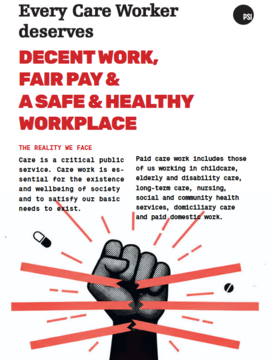
PSI has just released a new educational guide designed specifically for care workers. These practical materials help you identify hidden Occupational and Safety Health (OSH) risks in your daily work, carry out effective risk assessments, and take concrete action through your union to win stronger health and safety protections.
Whether you're facing violence from patients, lifting injuries from heavy loads, burnout from endless shifts, or infection risks without proper PPE, this guide gives you the tools to spot dangers early, document them, and organise collectively to stop them.
Care systems rely on the exploitation of mostly women, migrants, and minorities. Despite their vital contributions, care workers face discrimination, low pay and insecure working conditions. Their work is undervalued, underpaid, and they are overworked.
Care workers are exposed to a wide range of OSH risks, the main ones including the following (but not limited to):
Psychosocial, with workers exposed to violence and harassment, traumatic events, high workload, dealing with people at the end of their lives, the need to multitask, shift work, lone working, burnout, bullying and lack of control over work, all of which are known stress factors.
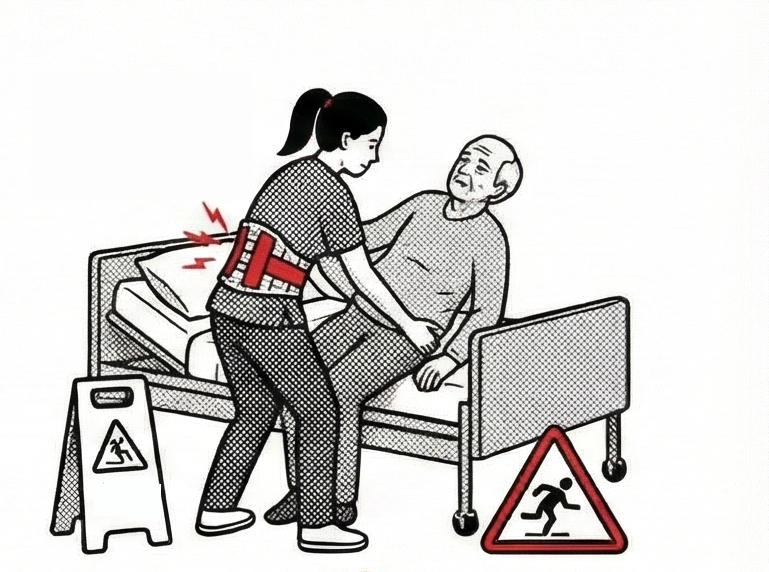
Ergonomic, linked to lifting loads, prolonged standing, high workload and working in awkward positions.
Biological, connected to any form of exposure to biological agents or infections. They include exposure to COVID-19.
Chemical, associated with the daily use of drugs or hazardous chemicals that pose a risk to those exposed to them.
Physical, such as slips, trips, and falls, radiation exposure, noise, and so on.
Informal care workers face additional risks, such as no access to personal protective equipment, exposure to unsafe waste disposal, inadequate sanitation, and a lack of recognition as workers.
These educational materials, produced by PSI, will help care workers around the world identify and mitigate risks, conduct risk assessments, and take action through their unions to secure stronger health and safety policies.
OSH risks are a unifying workplace issue that can engage all types of workers. If it affects one worker, it will likely affect all workers. Therefore, OSH is a powerful tool for organising workers and building a stronger union. These materials are a tool for our union members to build solidarity and organise their workplaces.
Who are these materials for?
These materials are for all types of care workers, both formal and informal, across all care sectors, such as:
Elderly care workers
Disability care workers
Childcare workers
Home carers
Nurses
Social Workers
Welfare workers