158th WHO Executive Board Watershed WHO EB meeting: PSI stands up for health workers and posterity
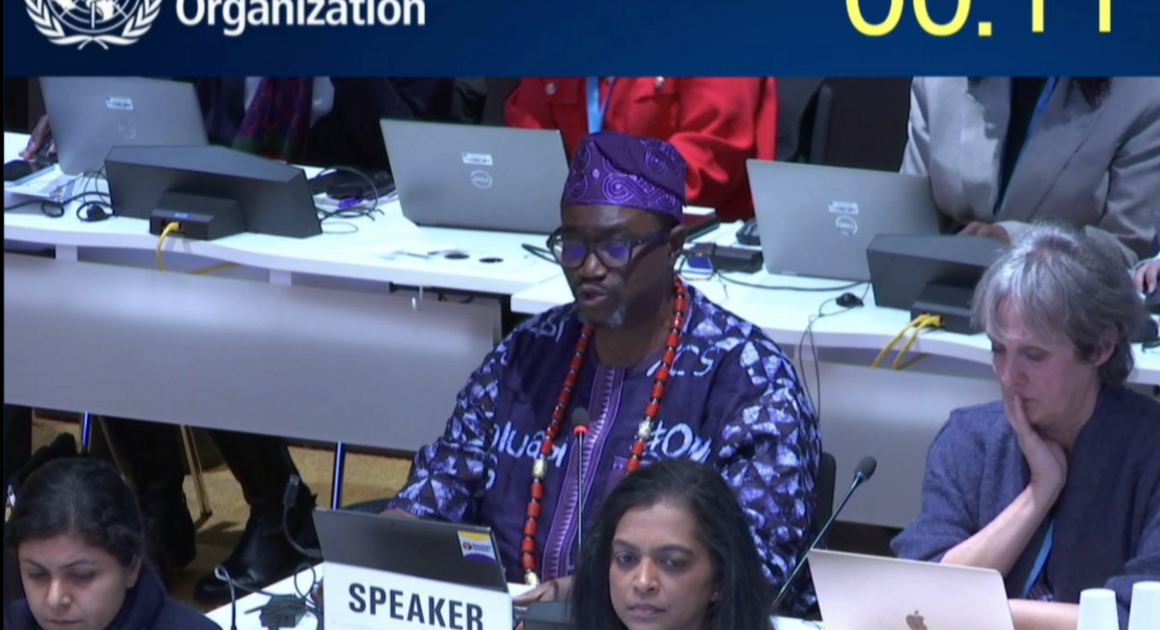 Baba Aye, PSI Health & Social Services Officer
The 158th Executive Board session of the World Health Organization (WHO) took place on 2 – 8 February. Ministers of health and other top policymakers in health from across the world and leading civil society organizations in the health sector gathered in Geneva for this watershed meeting. Taking place against the backdrop of multiple crises across the world, sharp geopolitical tensions, and the withdrawal of the United States from the WHO, it was a pivotal moment for the specialised United Nations agency vested with the powers of providing leadership for international health.
Discourse at the meeting reflected the contours of some of the tensions straining multilateralism in today’s world. Public Services International (PSI) was present as the global voice of health and care workers in official relations with the WHO, to engage in the important discussions that took place at this historic meeting. It was also an opportunity for us to engage with WHO Member States on a broad range of crucial issues of concern to health workers and health sector trade unions across the world.
At the EB plenary sessions, Member States deliberated on agenda items that would shape global discourse on health, leading to and during the 79th World Health Assembly in May. These included mental health, communicable diseases, universal health coverage, primary health care, health in the 2030 Agenda for Sustainable Development, WHO’s work in health emergencies, the WHO’s global health and peace initiative, and health conditions in Palestine. It also deliberated on a proposed strategy for implementing the recommendations of the WHO Council on the Economics of Health for All.
Issues and PSI’s interventions
The Executive Board opened with a moving speech by Dr Tedros Ghebreyesus, the WHO Director-General. He pointed out how 2025 “was a year of stark contrasts” for the Organization. It was “a landmark year” where the WHO Pandemic Agreement was adopted. But, it was also “undeniably one of the most difficult years” in the WHO’s history.
In light of the peculiar nature of last year, deliberations in the WHO this year, starting with the EB158 could not but involve “many discussions on reforming the ecosystem” of the Organization, as Dr Ghebreyesus said.
PSI intervened on several of these agenda items, with focus on the following:
Mental Health
Speaking on mental health, Bàbá Ayé, the PSI Health and Social Services Sector Officer, pointed out PSI’s grave concern that most countries are significantly off track in meeting the WHO Global Mental Health Action Plan’s targets. He noted that this places great burden on health and social care workers, especially as integration of mental health services into the universal health coverage (UHC) plans, as the report of the Director-General informed, has been inadequate for health workers.
In the PSI statement, we also underscored findings from studies that show that health workers face a mental health crisis in several countries. This is reflected in the higher risk of suicide which health workers face. This is up to 24% higher than in other sectors. PSI thus urged Member States of the WHO to ramp up efforts at strengthening mental health and psychosocial support for the populations of their countries and with dedicated programs for health workers.
This, PSI stressed, would require governments to address the overlapping drivers of psychosocial workplace risks, such as excessive work hours, job insecurity, violence and understaffing. Health sector unions, as key actors, should also be involved in the process, through collective bargaining and social dialogue.
Primary Health Care
PSI has always placed great emphasis on primary health care (PHC). It is the cornerstone to ensure universal access to quality healthcare. In the statement we submitted, we highlighted the centrality of our members to PHC across the world. These include community health workers, environmental health officers, nurses, doctors, and a broad array of other health technologists, technicians, and assistants.
We welcomed the WHO Director-General’s report on PHC and stressed that “prioritisation of PHC requires adequate investment and policy involvement of the PHC workforce”.
The report also informed EB members of WHO’s launch of a research programme “focussed on blended payment models for PHC” and “the WHO peer-to-peer learning programme, conducted jointly with the Global Financing Facility and the World Bank”. PSI expressed critiqued this model, pointing out that it will burden middle- and low-income countries in the long-run.
Instead of this approach which would deepen the commodification of health, PSI urged “Member States to instead push for fundamental reform of the global financing architecture” noting that increased technical and financial support for PHC should be “rooted in international solidarity, public ownership and accountability”.
International Recruitment of Health Personnel
The Executive Board received the final report of the WHO’s Expert Advisory Group on the WHO Global Code of Practice on the International Recruitment of Health Personnel. The Code was adopted by the 63rd World Health Assembly back in 2010. Member States of the WHO are required to report on its implementation by the governments of their countries every three years, while reviews of the Code take place every five years. Thus, it had its third review last year. Towards this, the Expert Advisory Group (EAG) was constituted and started its work in 2024. PSI served on the EAG, which presented its interim report to the 78th World Health Assembly last May. The final report that emerged reflected outcomes from further consultations had with Member States within the WHO Regional Organizations.
PSI welcomed the review by the EAG and further called for “redoubled efforts to stop the systematic exploitation of migrant health workers”. Migrant health and care workers are often denied basic labour rights, suffer precarious employment, deskilling and non-recognition of their qualifications. To address these, PSI called for strict regulation of the activities of recruitment companies to ensure fair and ethical migration. We also highlighted the need for Bilateral Labour Migration Agreements (BLMAs) in the sector to be transparent and negotiated through tripartite engagements in both the source and destination countries. Health worker migration, as we insisted, “must be made to benefit all parties equitably, with workers rights at the centre”.
Progress on health-related Sustainable Development Goals
The Director-General presented the WHO’s sixth report on the extent of progress on health in the 2030 Agenda for Sustainable Development. It was underwhelming: “the world remains significantly off track to achieve the health-related Sustainable Development Goals by 2030”.
PSI pointed out the systemic nature of the problem, noting that “from the MDGs to the SDGs, the tale has been the same.” The world had dared to dream of “health for all by the year 2000” at the 1978 International Conference on Primary Health Care in Alma Ata. But it was not an empty dream. The Alma Ata Declaration captured the interconnectedness between people’s health status and social inequality.
Thus, achieving the goal of universal health care rested on the vision of an international economic order that puts people’s health before wealth and geopolitical considerations. However, that vision was abandoned for a global political economy based on free-market fundamentalism and global public-private partnerships driven by philantrocapitalist foundations in the health sector as “multistakeholder” platforms.
PSI urged Member States to transform the global financial architecture and public health system with urgency and a renewed spirit to achieve qualitative change away from the current trajectory. The COVID-19 pandemic response, as we argued, shows that “radical changes can be rapidly made”.
WHO’s work in health emergencies
PSI acknowledged the WHO’s work in health emergencies despite severe funding cuts and commended the efforts of the WHO Secretariat. We pointed out that “health emergencies anywhere have the potential to become a problem for countries everywhere.” Thus, all Member States, particularly those in the Global North, need to deepen material support for the health emergencies program’s work across the world and strengthen its global architecture, in our collective interest.
We expressed our alarm at the horrors of attacks on health facilities and the killing of health workers and patients. This, we bluntly said, “is unacceptable.” And we added that it is not enough for WHO to identify cases of such attacks. It is time for WHO to integrate health worker protection and healthcare infrastructure safety as key priorities within the emergency preparedness framework. And this should be linked to Member States instituting mechanisms for accountability and prevention, based on international humanitarian law.
PSI expressed its appreciation of the complexity of each humanitarian crisis. However, we equally seized the moment to draw the attention of WHO Member States to the pressing need for decisive action to address the extremely dire situation in Sudan.
Health conditions in the occupied Palestinian territory
Once again, we expressed our grave concern as PSI at the catastrophic humanitarian crisis in Palestine and called on WHO Member States to address this with firm resolve. 94% of health facilities in the occupied Palestinian territory, have been damaged, according to the Director-General, in his report. And barely half can function at all, even if just to some extent. How can health services be provided under these conditions?
We also found it shocking that there was an 81.9% funding gap for WHO’s support to the emergency response in the territory. We thus urged Member States to contribute adequately.
The Director-General also reported that 1,581 health workers were killed and 359 detained with up to 180 still in custody even with the ceasefire. PSI has consistently taken a clear stand against the targeting of health workers in conflict zones. Health workers are not targets and should not be made targets to be killed, maimed or detained. This has to stop. We called on WHO Member States to demand the immediate release of all the health workers still being incarcerated in Palestine. We also called on WHO to collaborate with Palestinian health workers' trade unions. These are PSI affiliates and have been on the front line under the most debilitating of conditions.
Economics of health for all
The Executive Board considered the Director-General’s report, which introduced a draft strategy on the Economics of Health for All, 2026-2030. WHO setup a Council on the Economics of Health for All in November 2020, “to reframe health for all as a public policy objective”. In 2023, the 77th World Health Assembly received the report of the Council, which was chaired by Professor Mariana Mazzucato.
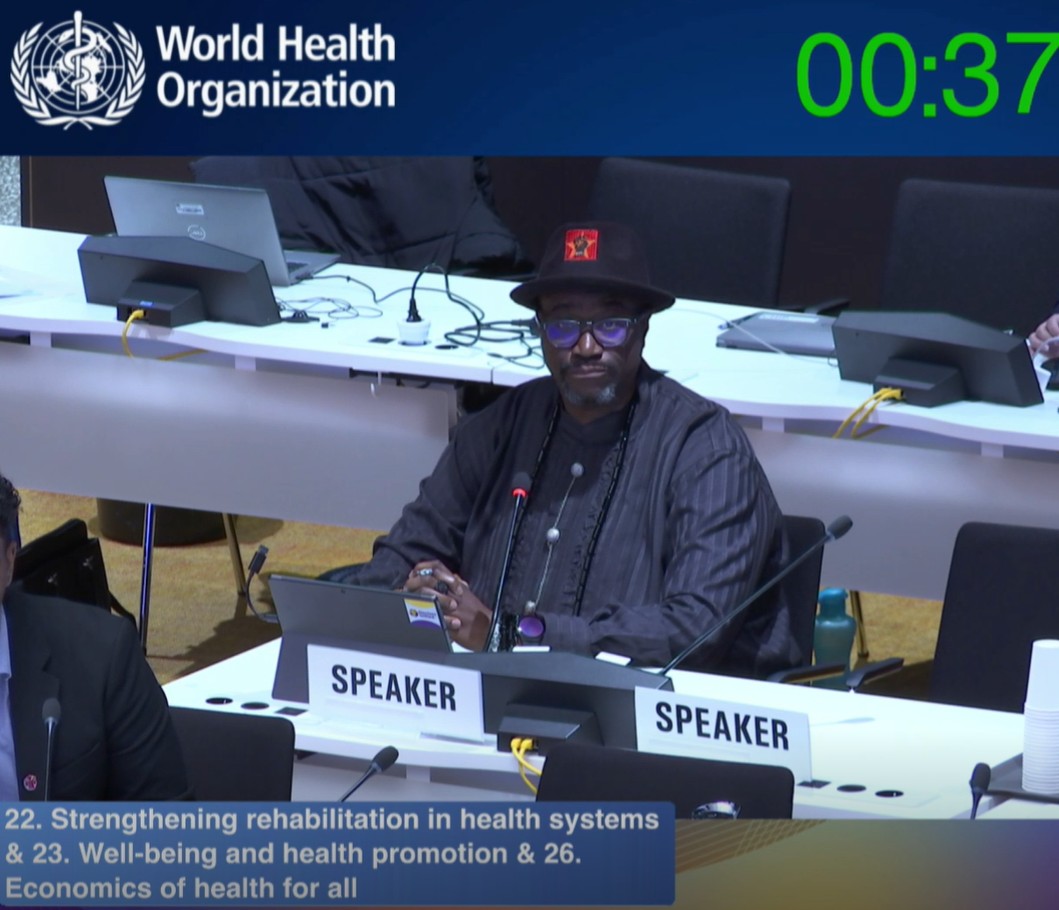
Expectations ran high at the time that this would mark “a significant step towards structuring global economies to priorities health and well-being for all”. But the draft strategy for the implementation of that report, which emerged from the WHO Secretariat’s consultation with Member States, was, as PSI highlighted at the meeting; “inadequate for achieving transformative action centring health in economic decision-making.”
We stressed the fact that health is much more than wealth and should be so treated. It is actually the most foundational of human rights. But health for all can be achieved only as part of a political choice to structurally reform the global political economy, decommmodify healthcare, curtail corporate power and unambiguously put people and the planet over profit.
PSI argued that the problem is not one of lack of wealth. The problem is systemic and requires fundamental steps that address it as such. Health inequities are interlinked with social and geopolitical inequalities. We thus urged Member States to take bold measures that would make a difference, telling them that “generations to come will ask what you did at this hour to make the world a better place where people’s health and not the superwealth of a few is what really counts.”
PSI/UNU/SID/G2H2 Side Event on the Economics of Health for All
PSI’s activities related to EB158 were not limited to engagement within the Executive Board meeting. Even before EB158 commenced, we organised an online pre-event. This was part of the policy dialogue series organised by the Geneva Global Health Hub (G2H2). We brought the voices of health workers in conflict zones to bear on the policy dialogue which was attended by policy makers from WHO Member States and the United Nations system, trade union leaders, and civil society organisations.
During the EB158 itself, we co-organised a side-event on Financialisation and the Economics of Health for All. The breakfast programme which held on Wednesday 4 February was organised by PSI alongside the United Nations University International Institute for Global Health (UNU-IIGH), Geneva Global Health Hub (G2H2) and the Society for International Development (SID).
Speakers at the programme drew attention to the power dynamics driving the commodification of health and undermining the achievement of the goals set by the Mazzucato-led Council. The session which was chaired by Bàbá Ayé, the PSI Health and Social Services Sector Officer, who is also a Co-President of the G2H2, also enabled several Member States that joined the discussion to raise their concerns on how the recommendations of the Council could be implemented.
Conclusion
The Executive Board meeting ended with hope, despite the challenging context in which it was held. The resolutions of the EB will be presented to the 79th World Health Assembly which will take place between 18 and 23 May, also in Geneva.
Despite cause to cheer, in the face of the challenges that WHO is facing, we also found the pushback against the admission of renewal of some civil society organisations official relations with the WHO due to their policy orientations, including on sexual and reproductive rights, worrisome. PSI thus joined thirty-three other Non-State Actors in official relations with the WHO to submit a constituency statement presented by the Save the Children Fund, at the end of the EB158.
It is also significant that the Chair of the Executive Board, Mr Blair Comley, who moderated the meeting with precision and depth singled out PSI as a Non-State Actor for the colour and depth of its interventions.
In the course of the following months leading to the 79th World Health Assembly, we will consult further with our affiliates in the health and social care services sector on the issues arising. From the country level to the global sphere, we will put forward the concerns of health and care workers and defence of the commons for posterity, with union power – now and always.