- Tags (4)
PSI Women's Committee Victory in Chile: PSI Members Secure National Care System
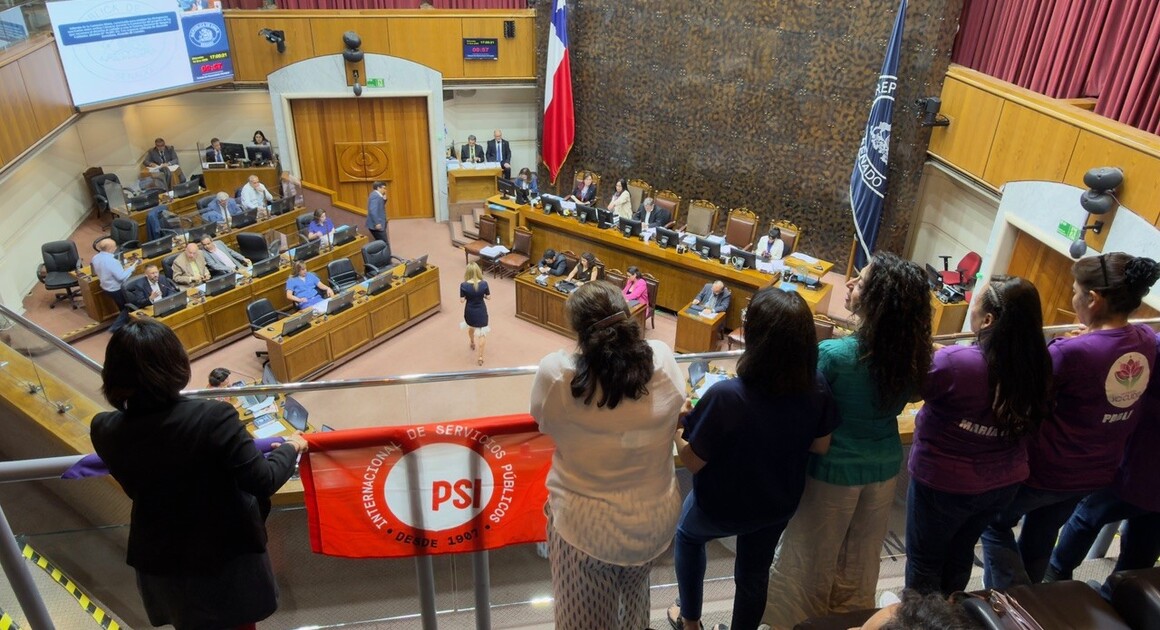

For decades, caregiving was an invisible task. An essential task sustained almost in silence by millions of women in homes, neighborhoods, public services and community networks. The pandemic came to bare this reality starkly: without care there is no life, no economy, no possible society. It was in this context that the debate on care took root in Chile and the world, driven by the feminist movement, social and trade union organizations and an international agenda that demanded recognition, redistribution and guarantee of the right to care.
In this process, Public Services International (PSI) played a decisive role in globally positioning the 5Rs of Care Manifesto - Recognize, Reduce, Redistribute, Reward and Reclaim - as a roadmap for structurally transforming the social organization of care. In Chile, the PSI Women's Committee took up this banner and turned it into concrete political action, establishing care as a human right and as a non-delegable responsibility of the State.
With the unanimous approval in the Senate of the Support and Care Bill, Chile took a historic step on January 14 towards the construction of a National System of Support and Care. For the PSI Women's Committee, this is not only a legislative victory but the crowning of years of political advocacy, union organizing and cultural dispute that succeeded in putting care at the center of public debate.
The law was passed with a broad cross-cutting consensus, reflecting the fact that care is no longer a private matter but a state policy. The text explicitly recognizes the right to care, to be cared for and to self-care, and establishes a system aimed at promoting autonomy, independent living and the prevention of situations of dependency throughout the life cycle. It also creates an institutional architecture aimed at coordinating public policies and services in areas such as health, social protection, disability, children and the elderly, overcoming the historical fragmentation of social policies.
The Minister of Social Development and Family, Javiera Toro, emphasized during the processing of the bill that the initiative "makes it possible to recognize care as a social right and to advance towards a public system that accompanies people in all stages of life, with a territorial and gender perspective". For her part, the Minister for Women and Gender Equity, Antonia Orellana, emphasized that "this bill represents a structural change in the way in which the State assumes the social organization of care, confronting one of the main sources of inequality between men and women".
From social dialogue to union advocacy
The bill recognizes that care has historically been invisible and unpaid, mostly performed by women, and enshrines the principle of social co-responsibility between the State, families, communities and other social actors. In this sense, the law constitutes a paradigm shift: care is no longer an individual burden but a collective and public responsibility.
The road to this approval was not spontaneous. Between April and June 2023, the Government of Chile, with the support of UN Women, promoted the national dialogues, a massive participatory process that brought together more than 12,000 people across the country, including self-convened meetings by social organizations, neighborhood councils, unions and interest groups. The PSI Women's Committee participated actively in this process, organizing union deliberations and systematizing proposals based on the concrete experience of women workers in the public sector, health, justice, central administration and municipalities.
At the same time, the Committee deployed a sustained advocacy strategy between 2023 and 2025. Through the podcast "Let's Talk about Care", national forums with authorities and parliamentarians, trade union schools on care economy and lobby meetings with authorities and legislators, it managed to place the issue on the trade union and political agenda. Its direct participation in the commissions of the Chamber of Deputies and the Senate made it possible to incorporate a view from the world of work in public services and the role of the State in the provision of the care system into the legislative debate.
From the beginning, PSI defended a clear position in the discussion of the National Care System. Its demands focused on the recognition of care as a universally guaranteed human right, on labor rights, social protection and decent wages for caregivers, or in other words, on decent work for paid workers in the sector; on the central role of the State in the provision, coordination and financing of the system; and on the need to limit the commoditization of care, preventing the logic of profit from capturing a fundamental social right and deepening inequalities.
For public sector trade unionism, care is not only a social policy, it is part of the reproductive work that sustains the economy and democracy. Placing care at the center implies questioning the sexual division of labor, redistributing responsibilities between the State, communities, families and the private sector as a complement, and building a new social pact based on the sustainability of life.
For Sandra López, member of the PSI Chile Women's Committee and vice-president for Women of the National Association of Public Employees (ANEF), the approval of this law "is a historic milestone for public sector workers and for all women who have sustained care without recognition or rights". "This system not only makes care work visible, but also opens the door to concrete policies that will redistribute care and recognize the work of millions of women who have been invisible for decades. The challenge now is for this law to be implemented with sufficient public resources and decent work for caregivers," she said.
In the words of Nayareth Quevedo, PSI sub-regional secretary for the Southern Cone countries, the approval of this law "marks a before and after in the way Chile recognizes care as a social right and a public responsibility."
"This law is the result of the struggle of thousands of working women who for decades sustained life without recognition or rights. Since PSI we have defended that care is a human right and that the State must guarantee it with quality public services and decent work for those who care. This is a triumph of our affiliates and of collective organization," she said.
A national victory with global impact
The approval of the National System of Support and Care does not close the debate, but opens a new political stage. Implementation will require sustained public funding, strong institutions, intersectoral coordination and permanent social participation. For PSI, the challenge will be to ensure that the expansion of the system does not translate into job insecurity, but rather into quality public employment, with civil service careers, collective bargaining and decent working conditions. It will also be key to prevent care from becoming a deregulated business niche, reproducing territorial and socioeconomic inequalities.
From Public Services International, the Chilean experience is observed as a regional and global reference. In an international context where care systems continue to be fragmented and highly privatized, the approval of this law positions Chile as one of the countries advancing towards a public care architecture, aligned with the recommendations of the ILO, UN Women and multilateral commitments on gender equality and decent work.
PSI has insisted that care must be a pillar of the welfare state in the 21st century, and that its organization cannot be subordinated to the logic of the market. In this sense, the approval of this law reinforces the global impact of public sector trade unionism and strengthens the international care agenda promoted by PSI in multilateral forums, regional conferences and political negotiation spaces.
The approval of the National System of Support and Care is, in short, a victory for public sector workers and all those who have sustained life in silence. Today, this work is beginning to be recognized as a central part of the economy, social justice and democracy. And for Public Services International, this advance confirms that the struggle for care is also a struggle for the future of work, for substantive equality and for a new social contract centered on human dignity.