- Tags (15)
in Ghana AFRECON 2025: Trade Union Tax Forum
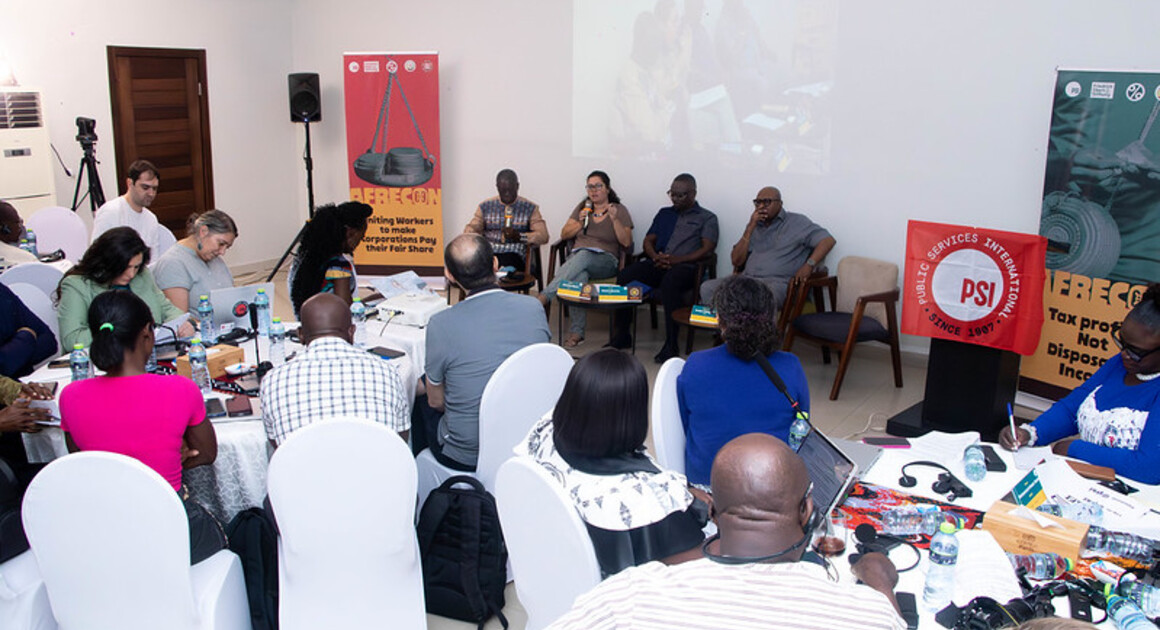
The Tax Forum denounced a global tax system that enables multinational corporations and the super-rich to avoid fair taxation, draining resources needed for public services, and called for urgent progressive tax reforms and reparative economic justice. Union leaders agreed to campaign for national reforms, advance a 25% Corporate Alternative Minimum Tax in selected countries, and mobilise labour and civil society support for a strong and inclusive UN Tax Convention.
- Read this in:
- en

Jesse Saidu
The 2025 Trade Union Tax Forum met ahead of PSI’s 14th AFRECON in Accra, Ghana, bringing together trade unionists, from both public and private sectors. Comrades heard from representatives of governments, international organisations, NGOs, and trade union experts and activists from around the globe.
For the first time, the Trade Union Tax Forum was held on the African continent. This forum took place at a time of rising geopolitical uncertainty, marked by the rise of right-wing governments, growing systemic risks, austerity, inflation, a rising cost-of-living crisis, and growing inequality. It is also at a time when the African Union has designated 2025 as the “Year of Justice for Africans and People of African Descent through Reparations.” A radical shift towards a fair and equitable global economic system, in which fiscal justice is advanced at national, regional, and global levels, is essential to undo colonial legacies that have long reinforced the existing global hierarchy, poverty, and consequently weakened the delivery of quality public services.
During the forum, participants further observed that:
The existing tax system favours the accumulation of wealth by a few people, mainly men. Within Africa, the four richest men have more wealth than half of the region’s population. Moreover, this wealth has been largely accumulated through dubious trade and fiscal practices, including massive underpayment of taxes.
Globally, multinational corporations pay rates well below those paid by the average worker. In Africa, the effective tax rates of large multinationals are between 5–8%. The failure of multinationals and the super-rich to pay their fair share of taxes deprives countries in Africa and around the world of resources for public services and development.
Tax justice is a class struggle issue. The regressive nature of the current tax system places a disproportionate burden of the responsibility to fund the state on the working class, especially those who spend most of their income on consumption goods and services.
We must tie together our different struggles as we pursue the fair distribution of wealth and power. Our demand for reparative justice must be echoed in our campaigns for tax justice.
The UN Tax Convention offers a critical opportunity to push for more inclusive global tax governance and fairer rules—leading to greater revenue collection. A UN tax convention has been a longstanding demand of the global labour movement and has been advanced by the African group of countries at the UN.
We applaud the African group for their continued and steadfast leadership in the struggle for the UN Framework Convention on Tax. Their steadfastness and commitment, which have indeed kept the momentum—resulting in countries in the Global North that were previously blocking the process now re-engaging—is a victory for both organised labour and Africa as a whole.
However, we also acknowledge that even while UN member states negotiate the convention, there are actions that countries must take now to urgently tackle multinational tax avoidance and illicit financial flows to boost their domestic revenue.
African governments need to urgently bring an end to the logic that drives public service financing—i.e., profits over well-being. They must change policies: no longer should it be the poor balancing national budgets through austerity, wage freezes, spiralling VAT, and new consumption taxes.
Digital service taxes, withholding taxes on service income, and renegotiation of tax treaties are all options available to states to unilaterally raise revenues from those with the greatest ability to pay—multinational companies.
Unions have developed a proposal for a Corporate Alternative Minimum Tax (CAMT) that proposes a minimum effective rate of 25%. This rate is inspired by the rate that workers pay from their wages—an average of 25%. It is also based on formulary apportionment that recognises value created by labour. This CAMT Bill would ensure that large multinationals pay their fair share.
Unions are successfully campaigning in their countries to reform their tax systems but face resistance from vested corporate and political interests, as well as barriers of technical capacity. Strategic corporate research targeting the tax behaviour of companies can be a powerful tool in collective bargaining and in highlighting the wider problems with the system.
Following a strategic discussion at the end of the forum, participants agreed to:
Focus trade unions’ campaigning on progressive national tax reforms in countries where progressive governments, strong labour movements, allies in civil society, and the need for increased revenue present an opportunity for change. Start by running citizen-focused awareness-building campaigns to raise the profile of tax justice and then advocate towards opinion leaders, politicians, and governments.
Campaign for a Corporate Alternative Minimum Tax in two to three key countries where conditions exist to win legislation in the next two years. This will require building a broad base of support—first in the labour movement and then in broader civil society—for this simple, home-grown solution to the problem of corporate tax avoidance.
Push for an ambitious UN Tax Convention by building or strengthening trade union and civil society alliances to present a united front towards UN member states.