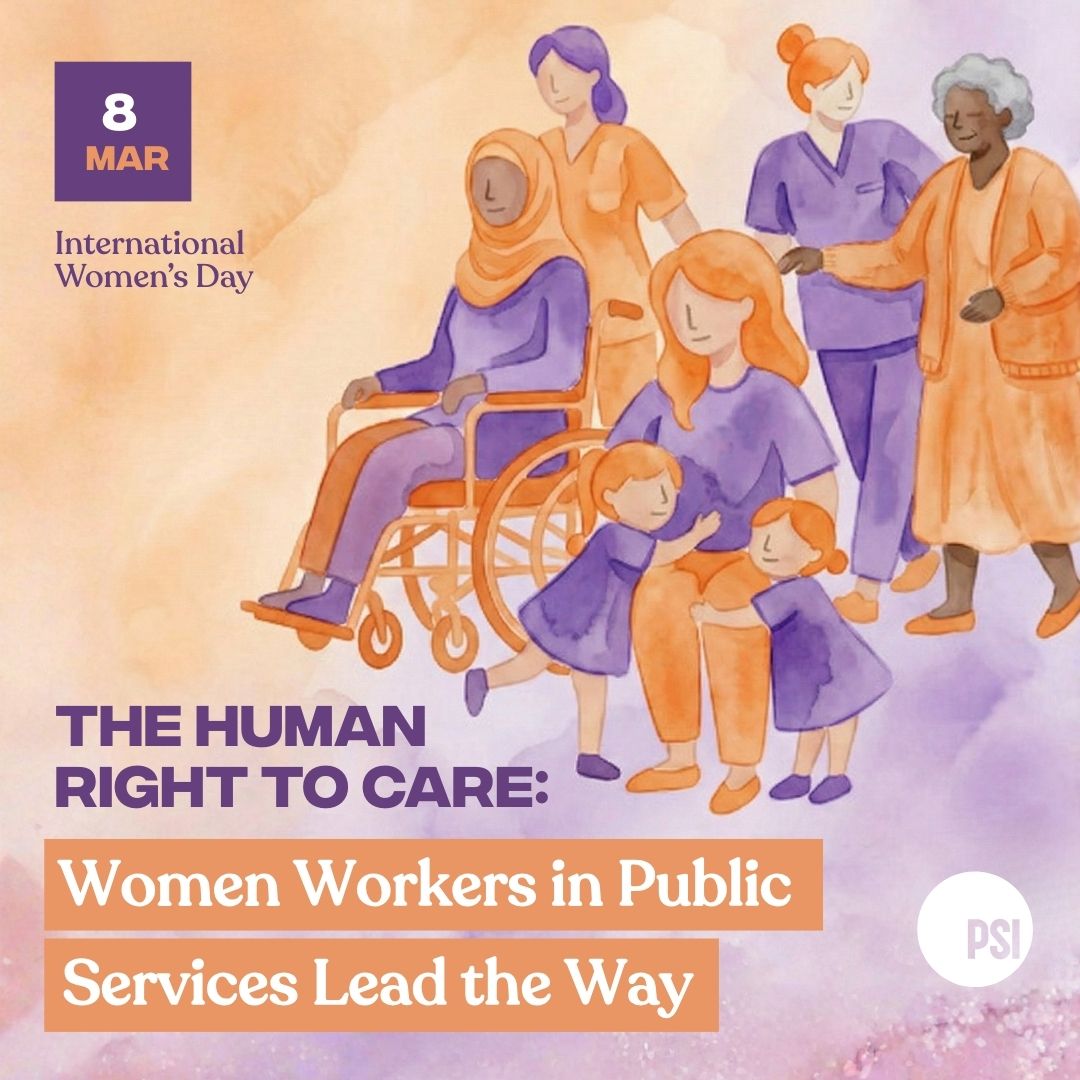
8 March - International Women's Day The Human Right to Care: Women Workers in Public Services Lead the Way
On 8 March 2026, International Women’s Day, women workers in public services across the world stand united in making visible their struggle to secure the recognition of care as a human right.

Verónica Montúfar
From workplaces to national legislation, public services unions are advancing this agenda through advocacy, social dialogue, and collective bargaining. Across regions, unions have contributed to important legislative and policy developments that recognise the right to care — in some countries establishing it as a standalone human right.
This momentum is reinforced by important international standards and jurisprudence. In 2025, the Inter-American Court of Human Rights, in its landmark Advisory Opinion OC-31/25, affirmed the existence of a right to care grounded in the principles of equality and non-discrimination, recognising both the right to receive care and the right to provide care under dignified conditions. This decision marked a significant step in consolidating care as a human rights issue within international law.
For women workers, the right to care is won through union power — and the world of work is one of its key battlegrounds.
The international labour standard, ILO Convention 156 on Workers with Family Responsibilities (1981), plays a central role. The Convention requires States to enable workers with family responsibilities to engage in employment without discrimination and, to the extent possible, without conflict between work and family obligations. It calls for measures such as leave policies, childcare services and adjustments to working conditions — measures that are most effectively realised through collective bargaining and strong social dialogue.
As highlighted by PSI World Women’s Committee Chair, Hitomi Kimura, JICHIRO (Japan):
“For women workers, the right to care is won through union power — and the world of work is one of its key battlegrounds. Through ILO Convention 156, collective bargaining, and strong social dialogue, unions turn promises into enforceable rights. At the negotiating table, they secure concrete protections — paid leave, flexible hours and social protection. These gains must be backed by universal public care services, including those provided directly by employers or guaranteed as workplace entitlements.”
This perspective is echoed by PSI affiliates, as the National Association of Fiscal Employees in Chile notes:
Although Convention 156 has been ratified and other legal frameworks exist, implementation is strongly linked to the exercise of collective bargaining
Findings from PSI Survey in Preparation for the ILC 2026 Gender Discussions
The following trends and priorities on Care Rights at Work are drawn from a PSI survey conducted among affiliated unions worldwide in preparation for the International Labour Conference (ILC) 2026 gender discussions.
Overall Trend
PSI-affiliated unions provided a revealing snapshot of current collective bargaining priorities, particularly regarding work–life balance and care responsibilities. The data shows that, while family-friendly provisions are beginning to take root in collective bargaining agreements (CBAs), coverage remains uneven, and significant gaps persist.
Progress is evident, yet uneven — some sectors and regions are advancing faster than others. However, these gaps also represent opportunities. Unions are actively expanding protections and demonstrating that workplaces can model care as both a human right and a labour right.
Flexible Working Hours
Flexible working arrangements are the most frequently negotiated measure, highlighting that working-time flexibility is a primary priority in collective bargaining. These arrangements are often comparatively easier to secure, as they may involve organisational adjustments rather than direct financial costs. Their prominence reflects a growing recognition of work–life balance needs.
Onsite Childcare Services or Childcare Subsidies
Childcare-related provisions occupy a substantial place in bargaining priorities, demonstrating increasing awareness of the structural barriers faced by working parents, particularly women. These measures support labour market participation, promote gender equality, and can be framed as an investment in retention, equality, and workforce stability.
Remote Work Options or Arrangements for Workers with Family Responsibilities
Remote or flexible-location arrangements represent a significant area of negotiation, reflecting post-pandemic shifts in workplace organisation. Their adoption varies across sectors and job types, particularly within public services, but they indicate the gradual institutionalisation of remote work in collective agreements.
Paid Care Leave
While less widespread than other measures, paid care leave is emerging as a distinct bargaining demand. It signals growing recognition of eldercare and broader dependency responsibilities. However, it may face resistance due to perceived direct financial costs.
Other Provisions
Provisions beyond these main categories remain limited, suggesting convergence around key work–family reconciliation priorities rather than a broader diversification of negotiated measures.
Persistent Challenges
A significant proportion of respondents indicated that they have not yet secured these provisions in their collective agreements. This reflects persistent disparities in bargaining power, uneven legal frameworks and differing sectoral conditions, leading to unequal access to care-related rights across workplaces and regions.
In response, public services unions have renewed and strengthened their commitment to advancing ambitious collective bargaining agendas that deliver concrete, enforceable gains for women workers. At the same time, they are intensifying and radicalising their advocacy for universal public care services — recognising that workplace protections and strong public systems must advance together to realise the human right to care and enforce equality.