- Tags (4)
Trade union organisation PSI unions in Inter-America: no collective bargaining and no right to strike, no democracy is possible
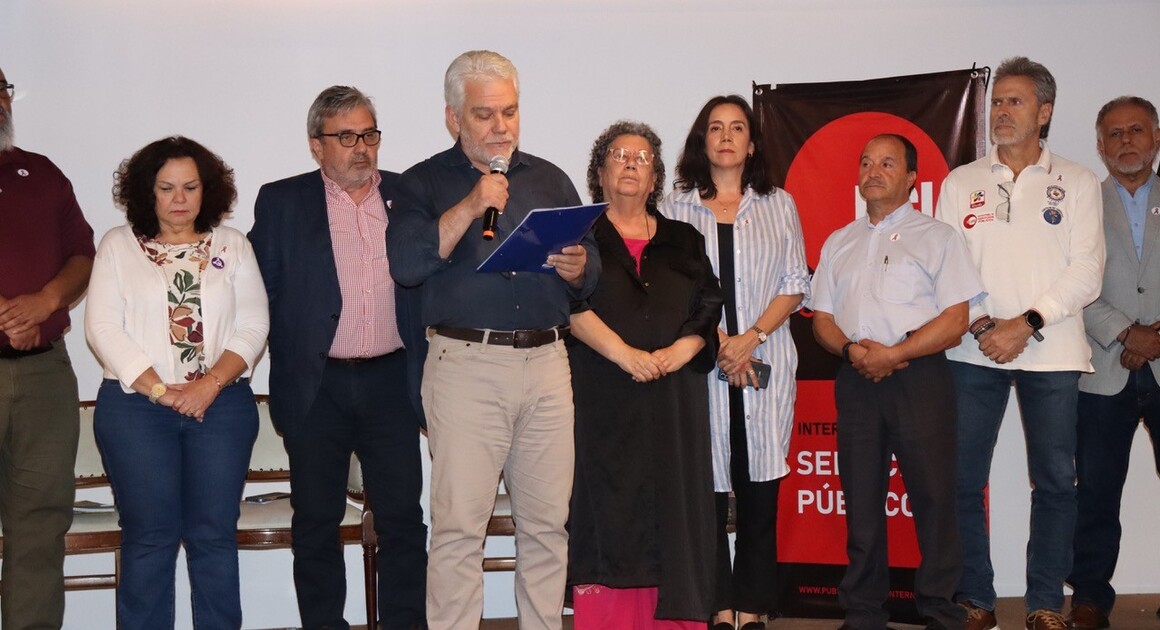
The statement follows a seminar promoted by PSI affiliate ANEF in Chile, which concluded with the adoption of the Santiago Declaration, which calls for strengthening public services, defending collective rights and confronting the advance of regressive projects in Latin America.

Nayareth Quevedo Millán
Santiago de Chile was the setting for the Regional Seminar "Collective Bargaining and the Right to Strike in Latin America", held on 19 November and organised by the National Association of Public Employees (ANEF), with the support of Public Services International (PSI), with the participation of delegations from different countries, historical leaders, specialists and workers from the public and private sectors.
The opening brought together ANEF President José Pérez Debelli, CLATE General Secretary Julio Fuentes, PSI First Vice-President Federico Dávila, CUT President José Manuel Díaz and Labour Minister Giorgio Boccardo. Their interventions coincided on something essential: when collective rights are weakened, democracy is weakened, and when trade union organisation is strengthened, societies become fairer and more cohesive.
The first panel, moderated by PSI's sub-regional secretary for ConoSur, Nayareth Quevedo, delved into the imminent ruling of the International Court of Justice on the right to strike and its link to ILO Convention 87. Interventions by leaders from Chile, Peru and Panama revealed shared realities: pressure, abusive minimum services, disciplinary threats and anti-union campaigns. The audience not only listened and intervened, but also asked questions and connected the legal with everyday life.
After lunch, there was a panel moderated by ANEF national secretary Carlos Insunza on comparative experiences of collective bargaining, with testimonies from Colombia, Costa Rica and Brazil. What became clear was that where collective bargaining exists, it transforms lives; where it is restricted, it expands precariousness.
The afternoon moved on to the more political panel, with representatives from Chile, Argentina, Brazil and the United States, who set the debate in the current regional context: conservative restorations, attempts to shrink the state, privatisations in disguise and discursive attacks on public workers. It was there that one of the phrases that marked the day emerged.
"If they take away our right to strike, if they silence collective bargaining, they not only take away our labour rights - they take away the possibility of defending the country we want. Democracy is also sustained in the hands of those who work", said the moderator of the panel and head of ANEF's International Relations, Angela Rifo.
The closing was marked by the reading and approval of the Santiago Declaration for Collective Bargaining and the Right to Strike, which reaffirms that strike and collective bargaining are human rights, demands an end to regressive regulations, defends gender equality, youth participation, and positions public services as common goods that sustain life.
The final photograph captured more than faces: it captured convictions. No one rushed to leave. The groups kept talking, exchanging phone numbers, and committing to meet again. Because what this seminar left behind was not just a document, but a shared certainty: trade unionism, when it speaks with a united voice, not only defends labour rights, it defends people's hope for a fairer, freer and profoundly democratic life.