- Tags (4)
PSI affiliates build the debate on Just Transition at First International Conference on Transitioning away from Fossil Fuels

PSI affiliates played an active part in the trade union space linked to the 1st International Conference on Transitioning Away from Fossil Fuels, as well as in the Conference itself, which took place from 24 – 29 April 2025 in Santa Marta, Colombia. This Conference was co-hosted by the governments of Colombia and the Netherlands and arose out of a recognition that the outcomes of COP 31 were insufficient to meet the challenges of the climate crisis, that the formal UNFCCC process was not delivering what is needed, and that there is therefore a need for spaces outside of the formal multilateral process for more ambitious and urgent actions to be agreed.

Sandra van Niekerk
The trade union space was convened by TUCA (Trade Union Confederation of the Americas), ITF, TUED and PSI, and met for four days of discussions, debates, and interventions. PSI trade unions who participated actively in this space included SINTRAMBIENTE, SUNET, SINEDIAN, ORGANISA from Colombia, as well as FNE Brasil, APOC Argentina, and FNV Overheid. PSI hosted four panel discussions during this period. The first highlighted the importance of Quality Public Services as a key component of a Just Transition. The second panel focused on the experiences of international public sector workers at the forefront of dealing with the impact of the climate crisis. The third panel focused on the ISDS and the call for countries to withdraw from ISDS provisions and the fourth launched the Colombian intersectoral mining and energy trade union coordination for a just and public transition (CITEJP). PSI affiliates also presented on other panels on issues ranging from the experiences and challenges facing the national fossil fuels public entity, ECOPETROL, to the urgent need for tax justice and tax reform, and to the assessment of the conference as part of a broader construction of a just transition agenda for the trade union movement.
Some of the key points raised by PSI affiliates in these panel discussions included a focus on the importance of:
· A public pathway for energy transitions – with ownership, governance and operations of energy utilities in public hands for the expansion of electricity to all, and the transition to renewable energy;
· Quality Public Services for the phase out of fossil fuels, and for a just and equitable transition;
· Increased public and climate financing, which is grants based so that country debt is not increased; with taxation reforms and the abandonment of full cost recovery as important elements of a financial system which is focused on strengthening the public sector
· An end to the ISDS (Investor-State Dispute Settlement) system, which undermines climate justice, and government climate action plans, by hindering government capacity to follow through with ambitious transition plans
We also heard about the experiences of trade unionists from Vanuatu, a Pacific Island particularly vulnerable to the impact of the climate crisis and their call for a new binding international instrument to manage the phase out of fossil fuels, with workers at the table every step of the way.
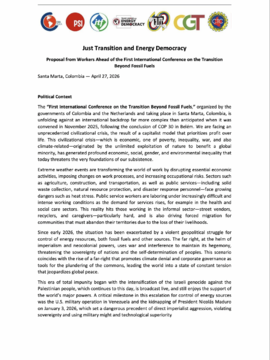
On the fourth day, the formal trade union dialogue was convened by the government of Colombia to consolidate a position on issues relating to transitioning away from fossil fuels. The outcome was a joint TUCA, PSI InterAmericas, ITF Americas and TUED position paper, which has also been signed by a number of other unions present in the meeting.
Marcelo Di Stefano, Secretary of organisation and unionising of TUCA, formally presented the position reflected in this paper to the Opening Session of the High Level Meeting of the Conference on Transitioning away from Fossil Fuels on behalf of the trade union delegation. The trade union delegation to this High Level Meeting consisted of 20 representatives from GUFs, trade unions and allied organisations, including the PSI affiliates already mentioned. Although the space to engage was extremely limited, trade union delegates highlighted key points of vital concern to the trade union movement. In the final plenary, PSI presented the conclusions on behalf of the trade union delegation, and raised the urgent need for more countries to follow the lead from the announcement of the government of Colombia and collectively withdraw from the ISDS system – a system that undermines the ability of governments to be able to pursue just and ambitious transitions to build more equitable societies with human rights and labour rights at their centre.
- Tags (4)
Just Transition and Energy Democracy
- Tags (4)