-
Tags (15)
- Cameroon
- Nigeria
- Palestine
- Health & Social Care Services
- PSI
- Congo, Democratic Republic of the
- News from our affiliates
- Africa & Arab Countries
- Trade Union Rights
- English-speaking Central, East and West Africa
- Arab Countries
- French-speaking Africa
- Quality Public Services
- Health & Social Care Services
- #NotATarget: The lives of health workers in Gaza must be protected
in Ghana AFREC0N 2025 - Panel Session: Protecting Health Workers in Conflict Zones
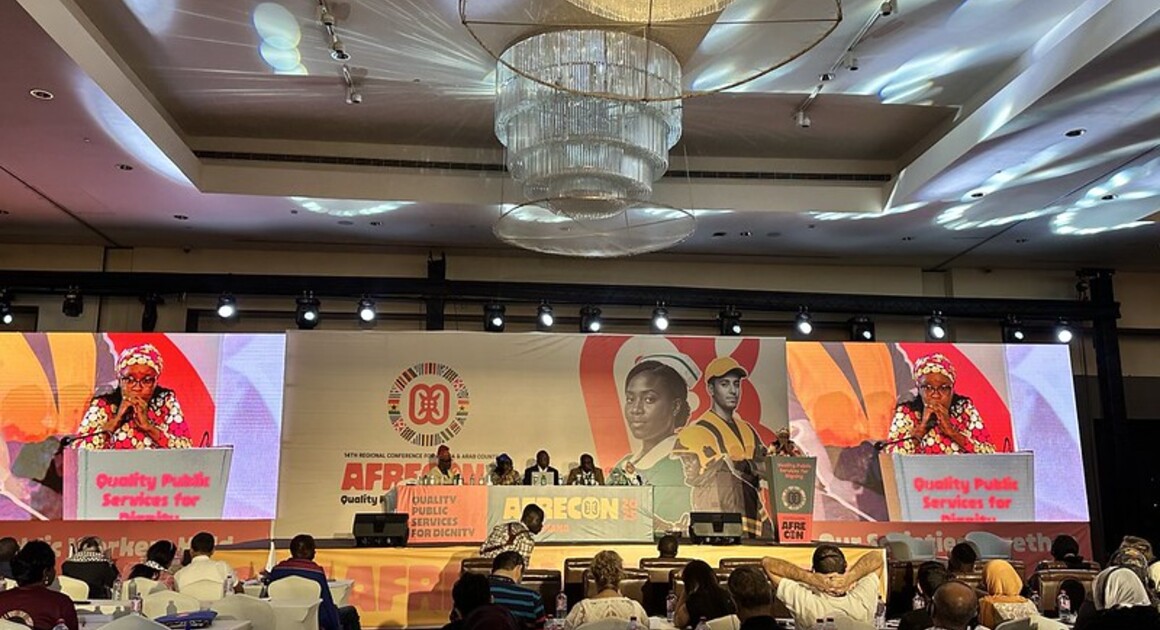
The panel condemned the escalating attacks on health workers and facilities in conflict-affected countries and called for strict enforcement of international humanitarian law, stronger national protections, and accountability for violations. Unions committed to intensifying documentation, legal and psychosocial support, gender-responsive protection measures, and coordinated regional solidarity to safeguard the lives, rights and dignity of health workers on the frontlines.
- Read this in:
- en

Jesse Saidu
During the African Regional Conference of Public Services International (AFRECON), a high-level panel was convened under the theme “Protecting Health Workers in Conflict Zones.” The session brought together union leaders, health professionals, and humanitarian advocates from Africa and the Middle East to discuss the growing dangers faced by health workers operating in conflict-affected areas.
This panel formed part of PSI’s broader program to strengthen the protection of health workers in crisis and war contexts. Across Africa and the MENA region, health systems already weakened by limited resources and fragile governance are being further destabilized as those responsible for saving lives become direct targets of violence. The session aimed to document the realities faced by these workers, assess regional trends, and propose coordinated strategies to ensure their protection, dignity, and safety.
The moderator opened the discussion by emphasizing that protecting those who heal is not only a moral responsibility but also a legal obligation under international humanitarian law. Health workers, who serve on the front lines of crisis, must be shielded from harm to safeguard public health and human life.
The Crisis of Violence Against Health Workers
Participants highlighted that attacks on health workers are not isolated incidents but form part of a broader and persistent pattern associated with armed conflict, political instability, and the militarization of civilian spaces. Medical personnel face intimidation, abduction, and physical assault; hospitals and clinics are looted or destroyed; and ambulances are obstructed or seized during emergencies.
Such violations undermine medical neutrality and erode public confidence in health systems. In some countries, armed groups forcibly recruit or detain health staff to treat fighters, while women health workers face heightened risks of harassment, assault, and exploitation. The cumulative effect of these attacks is the systematic weakening of health infrastructure and the loss of essential personnel in regions already struggling to meet basic health needs.
Regional Realities and National Experiences
Cameroon – Sister Élisabeth Bikim
In Cameroon, the sociopolitical crisis in the English-speaking regions of the North-West and South-West, ongoing since 2016, has severely disrupted the health system. More than six thousand people have died and over six hundred thousand have been displaced. Health workers are often accused of collaborating with either the government or separatist groups, placing them at risk from both sides. Hospitals have been burned, looted, or occupied by armed groups, and many professionals have fled or abandoned their posts.
Despite these challenges, the Cameroonian health union, supported by PSI, continues to organize training sessions, advocate for workers’ rights, and provide humanitarian relief to affected personnel.
Democratic Republic of Congo – Anaclet Sisho
Anaclet Sisho described the prolonged insecurity in eastern DRC, where more than 250 armed groups remain active. The region has witnessed the deaths of millions and the forced displacement of countless communities. Health workers are routinely targeted during attacks on hospitals or while delivering emergency services.
The Congolese union, with PSI’s assistance, has built a national solidarity network linking unions and civil-society organizations to document violations, strengthen dialogue, and support victims. The panel called for stronger enforcement of international conventions protecting medical staff and for accountability mechanisms to prosecute crimes against health personnel.
Nigeria – Dr. Ojonugwa Ayegba
Dr. Ayegba reported that persistent insecurity in northern Nigeria, particularly in Borno, Yobe, Adamawa, Kaduna, and Zamfara States, has led to the destruction of hospitals, the kidnapping and murder of health workers, and the collapse of essential services. Many health professionals now work without pay in displacement camps.
In collaboration with PSI, the Medical and Health Workers Union of Nigeria implemented the IDP Project to assist displaced workers and advocate for their protection. This initiative contributed to the adoption of a national policy on kidnappings in 2022. Dr. Ayegba emphasized the need for life-insurance schemes, legal protection, and gender-sensitive policies to safeguard frontline workers.
Palestine – Joairia Safadi
Joairia Safadi, President of the West Bank Health Workers’ Union, presented a moving account of the devastation of Palestine’s health system, particularly in Gaza. More than thirty-five hospitals have been destroyed, 136 ambulances targeted, and thousands of medical staff killed, injured, or detained. The lack of electricity, clean water, and essential supplies has resulted in a humanitarian catastrophe.
Safadi declared that in Palestine, caring for others has become an act of resistance. Despite the overwhelming conditions, the Palestinian union continues to document violations, train health workers, and advocate internationally for their protection.
Gender Dimensions of Violence
The panel underlined that women represent most frontline health workers in many conflict-affected regions. They face specific risks, including sexual harassment, assault, coercion, and social stigma that often prevents them from reporting violence. Midwives and community health workers operating in remote areas are particularly exposed.
A gender-responsive protection framework was identified as essential. Such a framework must ensure that safety policies, emergency protocols, and collective agreements explicitly address gender-based violence, guarantee safe reporting mechanisms, and provide psychosocial support for women survivors. Unions were encouraged to integrate gender perspectives into their safety negotiations, staffing policies, and advocacy strategies.
Union Responses and Good Practices
Across the regions represented, unions have emerged as vital actors in protecting and supporting health workers. They document violations, provide legal and psychosocial assistance, and conduct advocacy campaigns to hold governments and armed actors accountable. Collective bargaining has secured hazard pay, transport safety measures for night-shift staff, and emergency communication systems.
Through partnerships with PSI and FNV, unions have strengthened their role as early-warning systems and advocates for policy reform. These actions not only protect health workers but also reinforce the resilience of national health systems.
Voices from the Frontline
The testimony of Sister Eunice Bako from Kaduna, Nigeria, brought a deeply human perspective to the discussion. Kidnapped by an armed group and held captive for three months, she recounted the physical and psychological trauma she endured before being released through union intervention and PSI support. Her recovery and return to service stand as a powerful reminder of the courage and resilience of those who continue to care for others despite unimaginable risks.
Conclusions and Recommendations
The AFRECON panel reaffirmed that violence against health workers represents one of the most urgent threats to public health in Africa and the MENA region. Participants called for governments to enforce international humanitarian law, criminalize attacks on health facilities, and guarantee safe access to ambulances and medical supplies.
Unions were encouraged to continue documenting violations, train members in rights and safety protocols, and establish women-led reporting and protection mechanisms. International agencies were urged to provide resources for psychosocial care, rapid-response protection systems, and coordination with trade unions to improve on-the-ground safety.
Panelists also stressed that the protection of health workers must be recognized not as charity but as a legal and moral duty central to the right to health and human dignity.
Final Reflections
The AFRECON panel served as a platform for solidarity, testimony, and collective commitment. It amplified the voices of those who healed amid conflict and renewed PSI’s determination to defend them.
As the session concluded, one message resonated above all others: protecting those who care for others is protecting life itself. Ensuring the safety, dignity, and well-being of health workers is essential not only for them but for every community striving to survive and rebuild in the face of violence.