Fighting Privatisation Indonesian and Philippine Water Sector Unions Strengthen the Fight Against Privatisation
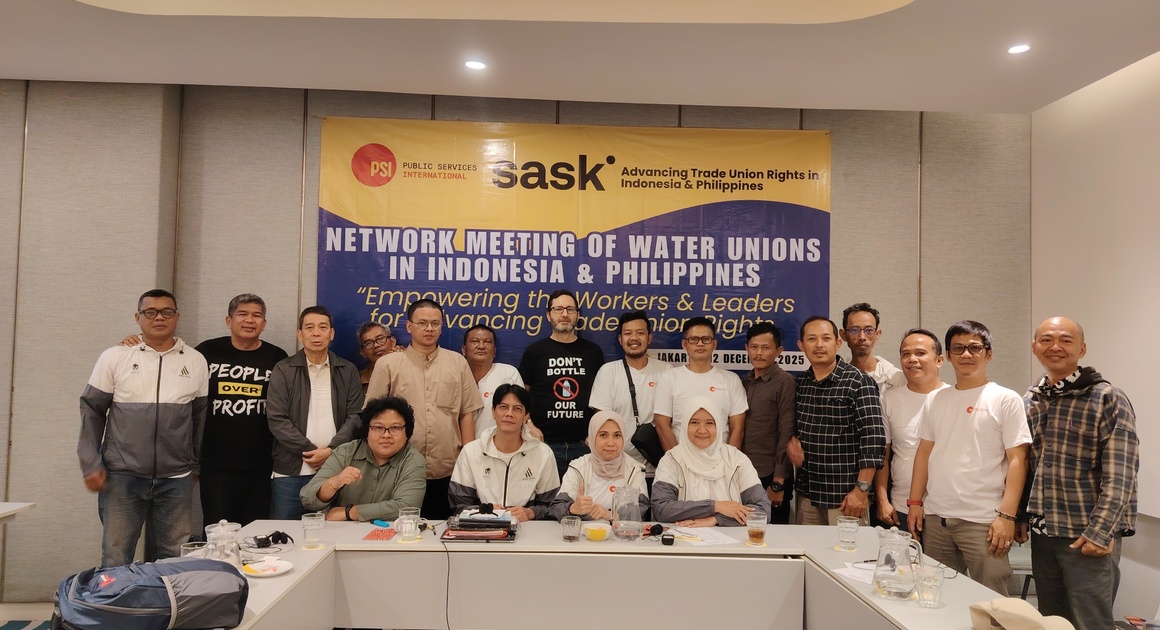
Water sector unions from Indonesia and the Philippines met in Jakarta to deepen cross-border solidarity and sharpen joint strategies against privatisation. Reaffirming that water must remain a public service, they exchanged lessons on resisting tariff hikes, protecting workers’ rights, and ensuring equitable access to safe, affordable water for all.

Indah Budiarti
Amid growing pressure to privatise and commercialise public services, water sector trade unions from Indonesia and the Philippines reaffirmed their shared position: water is a human right, not a commodity. This commitment was reinforced during the Network Meeting of Water Unions of Indonesia and the Philippines, held on 12 December 2025 in Jakarta.
The meeting provided a strategic space for water unions to exchange experiences, strengthen cross-border solidarity, and agree on joint steps to defend fair, affordable, and high-quality public water services. It brought together the PDAM Jakarta Workers’ Union and the Alliance of Government Workers in the Water Sector (AGWWAS) of the Philippines, with support from Public Services International (PSI).
In opening remarks, Ian Mariano, PSI Sub-Regional Secretary for Southeast Asia, stressed that the water sector lies at the heart of public services. When water is treated as a commodity, workers are harmed—but so too is the public’s right to essential services. Luis Monje from PSI similarly underlined the importance of strengthening union leadership capacity to respond collectively to the cross-sector and cross-country challenges posed by privatisation.
The first session examined the current state of the water sector in each country. Victor Chiong, President Emeritus of AGWWAS, described the extensive privatisation of water services in the Philippines. He noted that more than 70 cities and water districts are now engaged in joint ventures with private entities. Among the most visible impacts are the reduction of permanent jobs, weakened job security, and an erosion of union power.
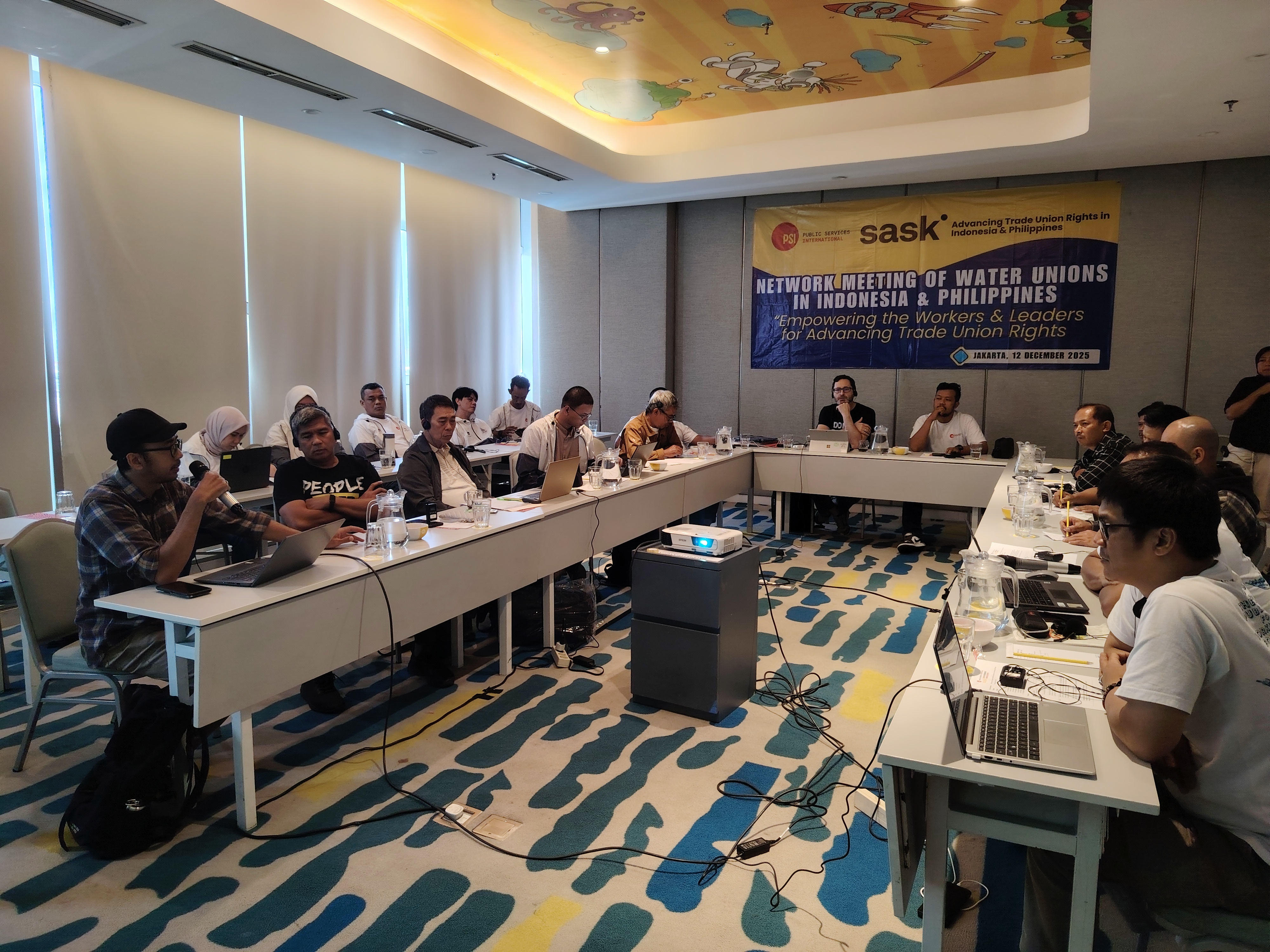
Victor outlined the consequences unions are confronting: attacks on job security and freedom of association, a shift from public service to profit-driven provision, steep water-rate increases, and declining water and sanitation quality. These outcomes, he said, are compounded by weak public consultation—particularly before tariff hikes—making it harder for low-income households to access clean water. In short, privatisation has pushed the state further away from its social responsibilities.
From Indonesia, Fachmi Islam, Secretary General of the Jakarta PDAM Workers’ Union, spoke about developments following the remunicipalisation of water services in Jakarta. While water management has returned to public hands, a new threat has emerged through proposals to change the status of Perumda to Perseroda. Unions warn that such a shift could open the door to private investment, potential acquisition of strategic assets, and the risk of rising tariffs.
In simple terms, a change from Perumda to Perseroda would transform a regional public company into a regional limited liability company with share-based capital—creating greater space for private participation. Fachmi stressed that this is not a technical or administrative adjustment, but a decision that shapes the future direction of water governance as a public service.
Fachmi noted that in a short period, water prices in Jakarta have reportedly risen by around 60%. He referenced Constitutional Court Decision No. 85/PUU-XI/2013, which affirms water as a public right under state control. Under this framework, private involvement is permitted only in limited form, under strict conditions, and must not undermine the state’s obligations or the public’s right to water. From the union perspective, changing PAM Jaya’s status to Perseroda risks contradicting these constitutional principles and could weaken democratic control over water.
To illustrate the risks, Fachmi cited the case of PT Jakarta International Expo (JIEXPO). After becoming a Perseroda, the private sector came to control 86.88% of its shares, while the DKI Jakarta Provincial Government retained only 13.12%. For unions, this example shows how restructuring a regionally owned enterprise can lead to loss of public control over strategic assets—raising concerns that a similar trajectory could follow for PAM Jaya.
The second session focused on defending unions’ fundamental rights. Victor Chiong shared AGWWAS’s approach to challenging restrictions on freedom of association in the Philippines, combining policy advocacy with membership strengthening. Saroha Simanullang, Legal Advisor for SP PDAM Jakarta, outlined legal and practical barriers in industrial relations that often disadvantage water workers and weaken collective bargaining power.
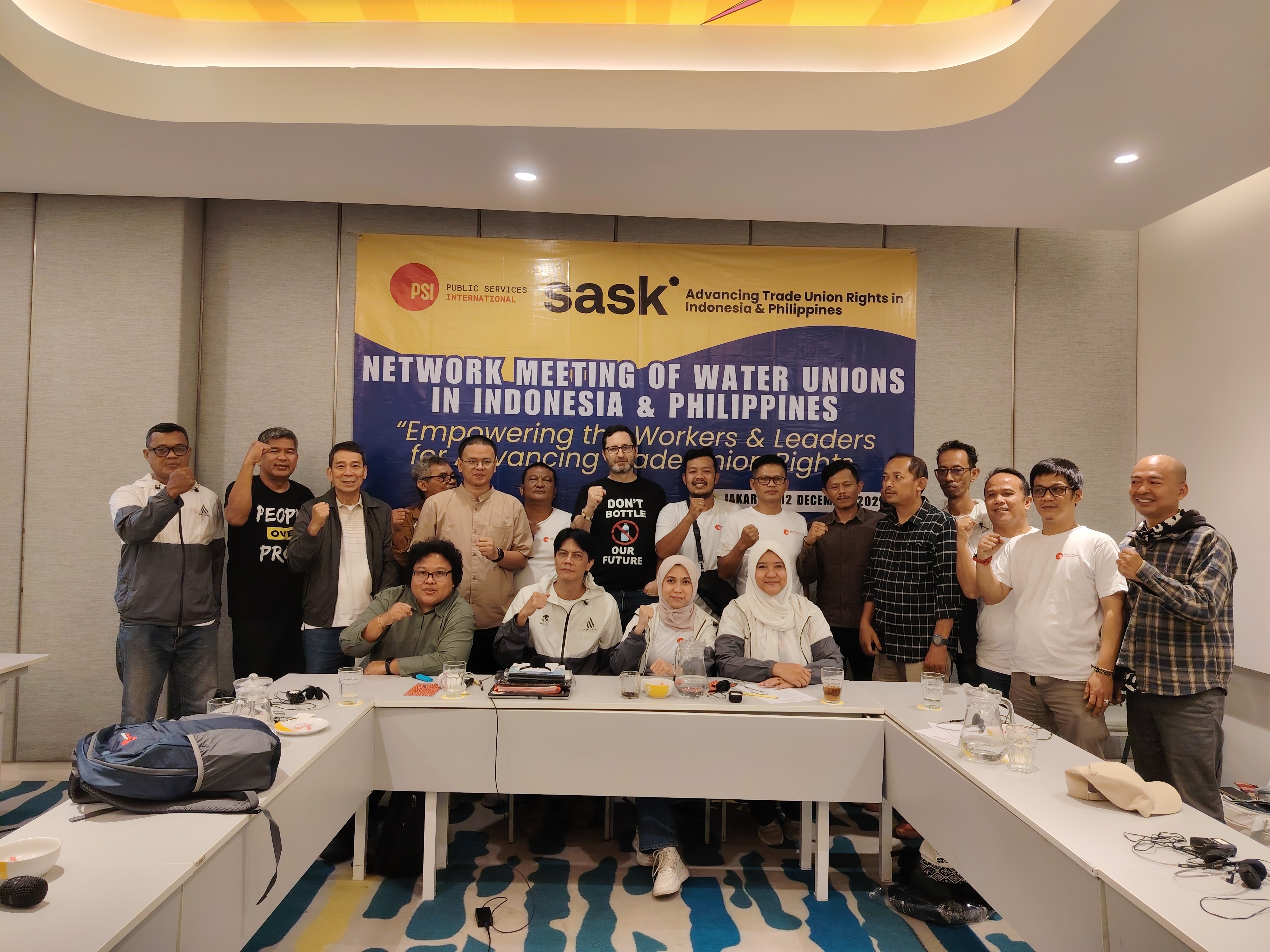
The meeting also included representatives from SP PDAM Tirta Intan Garut. Its Chair, Gun Gun, welcomed the opportunity to learn from the Philippine experience, warning that privatisation there has reduced state control, driven tariff increases, and created debt burdens for local governments. He emphasised that the harshest impacts are borne by low-income communities, who struggle to pay rising bills and face worsening inequality in access to clean water. “Privatisation is criticised for worsening access to clean water for many residents, especially the poor. It shifts water away from being a public service and turns it into a commodity that controls people’s lives—when it should remain under state responsibility,” he said.
Universal access to clean water was the focus of the third session. Arif Maulana from YLBHI emphasised that water is part of the human rights framework that the state must fulfil. He criticised the tendency to hand water management to market mechanisms, arguing that this moves away from social justice and transforms water from a public service into an economic commodity.
The discussion concluded with a fourth session emphasising joint work to strengthen cross-border union solidarity and capacity. Participants agreed that privatisation of the water sector is a global challenge requiring a collective response. The exchange between Indonesian and Philippine unions was seen as a valuable foundation for strengthening the anti-privatisation campaign and expanding advocacy networks across Southeast Asia.
The meeting reaffirmed that water sector unions play a strategic role in keeping water within a public, democratic domain. In the face of liberalisation and commercialisation, cross-border solidarity remains essential to defend water as a public right. Jakarta’s discussions underscored that the struggles of water workers in Indonesia and the Philippines are not isolated—they are connected, and part of a wider fight against structural injustice in public services.