- Tags (4)
in New York CSW70: Motion of No Action Blocks US Resolution on ‘Gender’ Amid a Global Dispute and Strong Trade Union Involvement
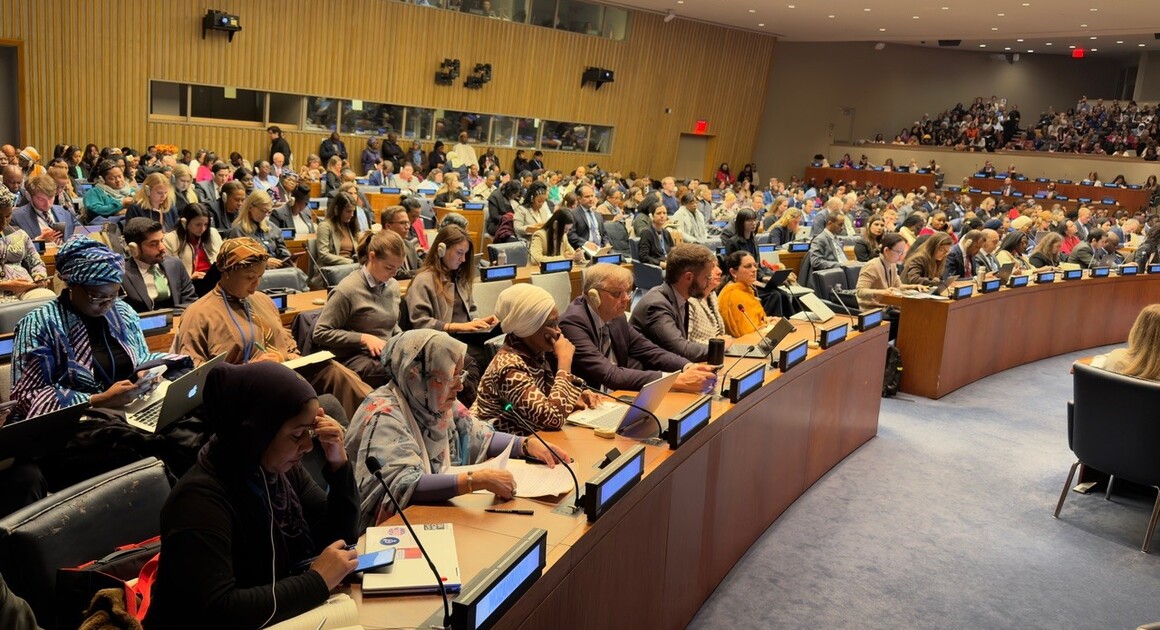
The 70th session of the Commission on the Status of Women was marked by an unprecedented event: a motion of no action tabled by Belgium blocked the vote on a resolution put forward by the United States that sought to redefine the term “gender” within the United Nations framework.

Nayareth Quevedo Millán
The 70th session of the Commission on the Status of Women (CSW70) was marked by an unprecedented event: a motion of no action tabled by Belgium blocked the vote on a resolution put forward by the United States that sought to redefine the term “gender” within the United Nations framework.
The US proposal, submitted in the final stage of the process and without prior consultation, sought to establish a restrictive interpretation of the concept based on Annex IV of the Beijing Declaration and Platform for Action. The initiative met with widespread rejection among member states, not only because of its content but also because of the procedure used.
On behalf of the European Union, Belgium strongly criticised the text, noting that it “is factually incorrect” and that it “attempts to rewrite what was carefully agreed over 30 years ago”. It also warned that it was unacceptable to force through decisions without negotiation or consultation, in a forum whose legitimacy rests precisely on consensus.
Faced with this scenario, Belgium tabled a motion of no action—an exceptional measure—to prevent the draft from being considered. The initiative was backed by countries such as Brazil, which highlighted the absence of the minimum conditions required for serious multilateral deliberation. The motion was finally approved by 23 votes in favour, 3 against and 17 abstentions, completely blocking the resolution.
The United States criticised the decision, claiming that it sets a precedent that “erodes the working methods” of the multilateral system. However, for a majority of delegations, the problem was not only substantive but also procedural: it was a matter of preventing the introduction of new definitions without intergovernmental negotiation.
PSI’s trade union advocacy
Beyond this formal episode, the process was marked by an intense political dispute in which the international trade union movement, particularly Public Services International (PSI), played an active role.
We fought hard to take action against the US proposal. The collective effort of the PSI delegates was crucial.
Through the coordination of its delegations – including some government delegations – participation in parallel forums and direct lobbying of member states, PSI helped to uphold positions in defence of international human rights frameworks, including the Beijing Platform for Action. This advocacy was crucial in reinforcing the stance of several countries that defended the agreed language and resisted attempts to roll back progress.
Coordinated work between trade unions, civil society and like-minded delegations also made it possible to include structural issues in the final conclusions, such as access to justice in the world of work, care systems and the strengthening of public services, in a context of high political fragmentation.
‘We fought hard to take action against the US proposal. The collective effort of the PSI delegates was crucial. We spoke at length with the Brazilian negotiator to ensure that our struggle was reflected in our country’s position. Let’s continue to stand together in the fight for all women’ – Shirley Morales, National Federation of Nurses, Brazil
The dispute over the concept of gender
The delegations’ interventions showed that the controversy goes beyond a semantic definition. On the one hand, a bloc of countries—including the United States and other countries that expressed reservations—insisted on limiting the concept of gender to a binary interpretation based on biological sex, further subordinating international commitments to national, cultural or religious frameworks.
On the other hand, a broad group of states defended the integrity of existing international agreements, warning that reopening concepts already negotiated puts decades of progress in women’s rights at risk.
At the same time, a cross-cutting tension emerged around multilateralism; whilst various countries agreed in lamenting the breakdown of consensus—for the first time in the history of the CSW—the underlying reasons diverged profoundly. For some, the problem was the inclusion of certain concepts; for others, the attempt to restrict them.
In this context, the no-action motion not only blocked a resolution but also marked a turning point in the Commission’s dynamics: the dispute is no longer solely over the content of agreements, but also over the rules under which they are constructed.
CSW70 thus concludes by highlighting a reconfiguration of the global debate on gender equality, in which state and non-state actors — including the trade union movement — are playing an increasingly decisive role.