- Tags (5)
Colombia: PSI unions reaffirm their leadership in the care sector during national meeting


The III Meeting for the Future of Care left as a central result a collective call -from social organizations, unions, territorial entities and international cooperation- to guarantee the continuity and strengthening of the National Care System in the face of institutional changes in the country. This consensus, built during three days of exchange, reaffirmed that the defense of the right to care is today a political priority that demands State responsibility, recognition of those who care, decent work and long-term commitment to strengthening public care services.
The meeting held from December 3-5, 2025 in Bogota was co-organized by the Ministry of Equality and Equity, Public Services International (PSI) together with a broad group of international cooperation entities, such as UN Women, UNDP, OXFAM, the Global Alliance for Care and ECLAC. PSI affiliates highlighted the role of the trade union movement in the formulation of public care policies that commit the State to public care services with decent work.
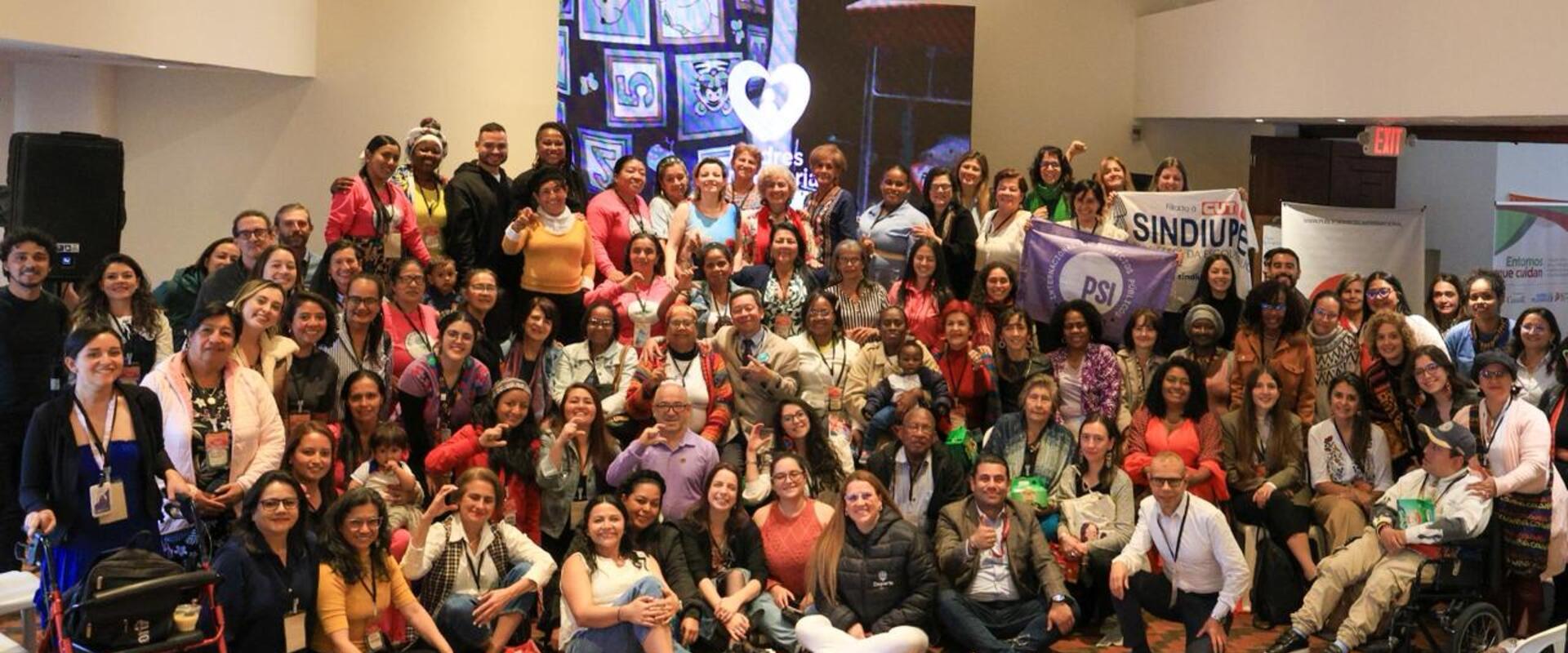
"The state must assume its responsibility in the provision of public care services, and it is essential that the trade union rights of paid care workers are guaranteed. The struggle for care is a struggle that we must wage together with unpaid caregivers, as a trade union movement and as a society," said Susana Barria, PSI sub-regional secretary for the Andean Region.
The meeting also made it possible to measure the magnitude of the challenge: 17 million people require care in Colombia (35% of the population) and 6.5 million perform unpaid care work, 75% of them women. These data, presented by the Ministry of Equality and Equity, show the need to consolidate a system that redistributes care responsibilities from families to the State, through quality public services for dependents. PSI affiliates insisted that without stable investments, commitment to the public provision of services and union strengthening, it will not be possible to sustain the progress achieved.
The international conference brought together experiences from Uruguay, Ecuador, Chile, Mexico, Brazil and Catalonia, who shared lessons learned to consolidate comprehensive care systems and highlighted the role of trade unions in their sustainability. Sharing about the experience in Chile, Sandra López of ANEF stressed the need to consolidate an understanding of care as a fundamental human right. "The implementation of the National Care System is an essential step in guaranteeing this right, advancing gender equity and strengthening public services. We need a program that includes the consolidation and expansion of existing programs, in order to move towards the universalization of services. The case of child care services has much to teach us from this perspective."
For her part, Mariangele Zambon of SINDIUPES, Brazil, shared the role of PSI Brazil's women's committee in the formulation of care policy, and the concern of the push for Public Private Partnerships (PPPs) as a magic solution to funding needs, which resonated with the Chilean experience. "We are against PPPs because international experiences, both in the water sector, health and climate policies, have shown that PPPs are public funding for private benefits with low quality of services and deteriorating working conditions. We need real long-term solutions and the market is not a guarantor of rights," said Zambon.
Claudia Sule, PSI sub-regional secretary for Central America, Mexico and the Dominican Republic, shared the SNTSS union's successful process to expand and expand child care services through collective bargaining in the framework of the implementation of the National Care System. "SNTSS negotiated with the Mexican Social Security Institute (IMSS), its employer, to increase the staff of the children's centers; to recognize the technical and pedagogical qualifications of the workers embodied in the tabulator for workers in the children's centers resulting in a significant salary increase; as well as to open the children's centers in the maquiladora zones in the north of the country. As well as the negotiation with the DIF in which non-IMSS contributors are benefited. This last point gives us guidelines to think of workplace daycare centers as part of a public service for the neighborhood and the community with a universal character," Sule emphasized.
Picking up on the challenges that focus on expanding coverage and improving services for people in situations of dependency, within a framework of financial sustainability and fiscal responsibility, Patricia Cossani, from the National Secretariat for Care and Disability of the Government of Uruguay shared the proposals of the Frente Amplio for this third agenda for the development of the National Integrated Care System. "We are developing a proposal for a National Care Fund that combines fiscal spending, co-payments, raised as an equity tool where each person contributes according to their ability to pay, and employer contribution. As for the right to the service, access should be universal and determined exclusively by the level of dependency. This moves away from the pure insurance scheme and favors a solidarity structure", concluded Cossani.
The meeting closed with the symbolic signing of the Pact for the Future of Care, which includes the collective commitments. The priority now is to ensure that what has been achieved is not rolled back and that the right to care is consolidated as a pillar of equality and social justice in the country. The challenge is already visible with the deterioration and cuts in services that have been visible in Bogotá since the arrival of right-wing mayor Carlos Fernando Galán. Only the joint union and community struggle will be able to defend the advances and continue building the society we dream of.