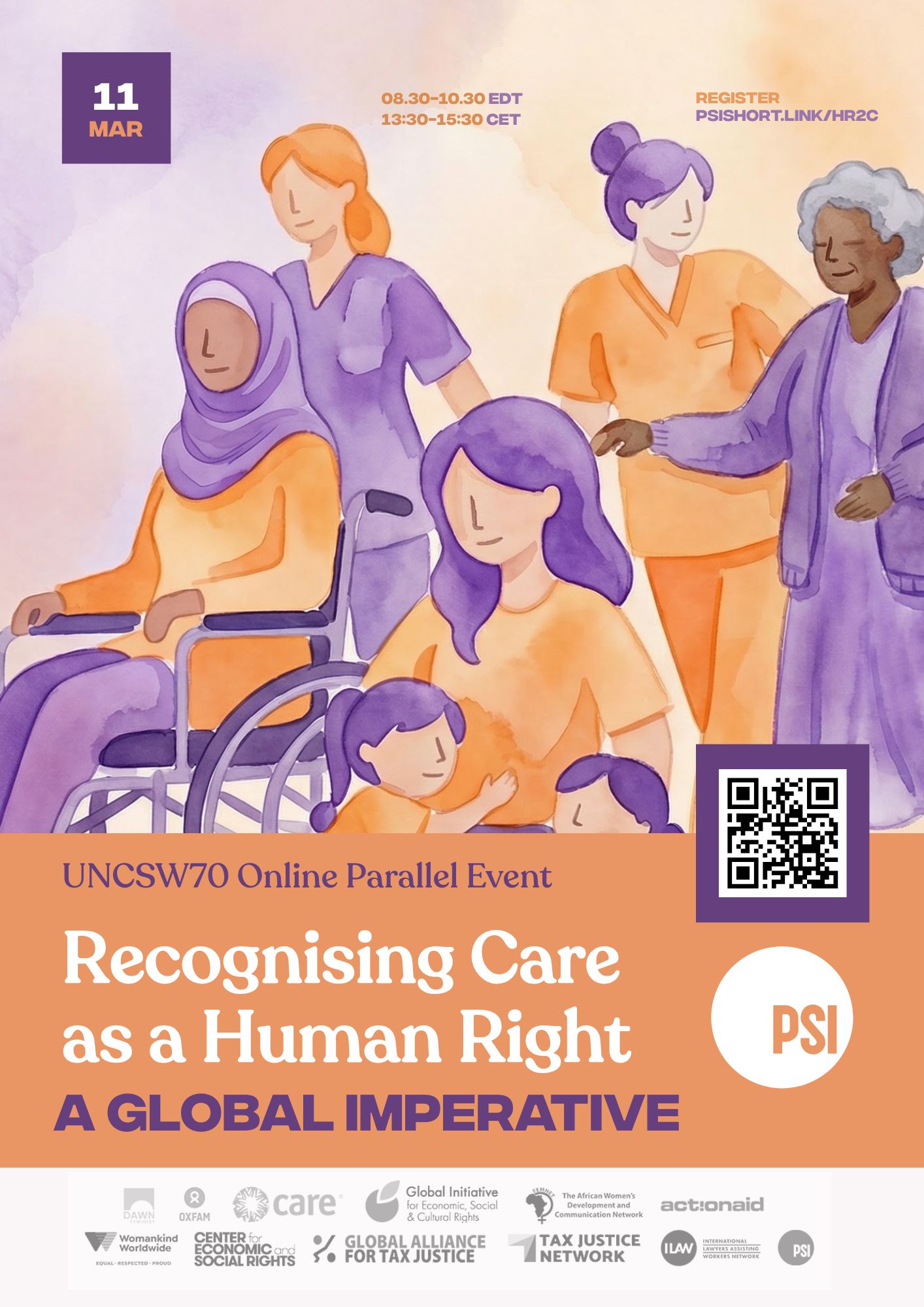
Recognising Care as a Human Right: a Global Imperative
- 11 Mar - 11 Mar
- New York, NY, USA
08:30 - 10:30 EDT
This online parallel event aims to build global momentum from the jurisprudence of the Inter-American Court of Human Rights to strengthen advocacy for recognising care as a human right within national legislation worldwide, extending beyond Latin America and the Caribbean. It will present findings from a broad-based review of current care contexts in Europe, Africa, Asia, and North America. The discussion will examine existing care-related legislation and policy initiatives, highlighting both achievements and persistent gaps, assess recent advances in the privatisation of care, and explore emerging experiences of remunicipalisation where they exist, identifying lessons to inform future rights-based advocacy.
Wednesday 11 March 2026 - 8:30-10:30 am EDT | 13:30-15:00 CET
Interpretation in SPANISH | FRENCH | ENGLISH
Video
This online event builds global momentum around the 2025 Advisory Opinion from the Inter-American Court of Human Rights, which recognised care as an autonomous, standalone human right, encompassing the right to give care, receive care, and self-care, while centering care workers’ rights and linking care to broader human rights, dignity, equality, and non-discrimination.
Global Coalition Calls for Care to Be Recognised as a Human Right Worldwide
REGISTER HERE
Public Services International is the global union representing care workers, most of them women, across public, private, non-profit and community sectors. PSI also defends the rights of public care service users, advocating for care as a human right, as set out in its Care Manifesto.
The event will be co-sponsored with ILAW, ActionAid, FEMNET, DAWN, GI-ESCR, OXFAM, WomanKind, Care International, GATJ, CESR and TNJ
Download
Find out more about PSI at CSW70
Background
Care is foundational to social reproduction, gender equality, and the sustainability of political and economic systems. In August 2025, the Inter-American Human Rights Court issued a historic consultative opinion (OC 31/25) recognising care as a standalone human right, advancing a rights-based approach for communities and care workers—the majority of whom are women, which represented a victory for the labour and social movements' transformative agenda. On the other hand, dominant global economic forces continue to maintain care as systematically undervalued, underfunded, and increasingly commodified, shaped by austerity, privatisation, and market-driven reforms that undermine states’ obligations.
To inform transformative action, PSI conducted a broad-based research study reviewing care initiatives, legislation, and policy successes and gaps, privatisation trends, and experiences of remunicipalisation, offering a global perspective beyond Latin America and the Caribbean. Cross-regional research highlights common structural patterns that hinder the recognition and realisation of care as a human right.
Progress towards a right-based vision of care remains highly uneven across regions, with care often continuing to be treated as a private burden rather than a public good. While care as a right is gaining traction in international discourse, it is often only indirectly recognised through other rights. In Africa, regional norm-setting and national reforms are strengthening legal recognition of care-related labour through equality, labour and social protection frameworks. In Europe, the European Care Strategy has improved policy coordination on access, quality, affordability and workforce capacity, but implementation remains uneven and often focused on labour-market measures rather than universal rights. In MENA and much of Asia-Pacific, care continues to be framed as women’s unpaid private responsibility, with limited legal protection and growing privatisation. While some countries are developing care roadmaps and extending social protection, progress is fragmented and rights focus is limited. In North America, childcare reforms mark a shift towards care as a public good, but sustainability is challenged by underfunding, workforce instability and long waitlists. Across all regions, unions and civil society play a critical role in advancing care rights, yet progress is constrained by limited political will, fiscal pressures, weak enforcement, informality, social exclusion and entrenched gender norms.
In the context of the 70th session of the United Nations Commission on the Status of Women, the Rebuilding the Social Organisation of Care Manifesto-Core Group is holding a parallel event that aims to build global momentum for recognising care as a human right in national legislation worldwide.
Objectives
Present findings from a broad-based review of care-related legislation, trends, and policy initiatives in Europe, Africa, Asia, MENA, and North America.
Offer a keynote reflection on advancing the effective recognition and implementation of care as a human right, centring care workers’ rights globally, the majority of whom are women.
Share feminist political economy insights by:
Analysing how global economic systems, austerity, privatisation, and international financial institutions shape care policies and outcomes, often in contradiction to the human right to care.
Examining financing care through a human rights lens, including macroeconomic dimensions, multilateral commitments, and political will for transformation, linking global and regional policy to national realities and lived experiences.
Building collective strategies among labour and social movements, providing advocacy directions and calls to action beyond CSW70.
Draft Agenda
08:30–08:40 | Opening and Framing
Welcome and objectives. Berivan Öngörur, PSI-VISION
Positioning care as a human right and public good. Daniel Bertossa, PSI General Secretary
08:40–09:20 | Care as a Human Right. Where We Stand Today
Research findings, Georgia Montage-Nelson, Global Labour Institute
Keynote response on advancing care as a human right, centring care workers’ rights globally, Jeff Vogt, ILAW NetworkModerator: Berivan Öngörur, PSI-VISION
09:20–10:00 | Feminist Political Economy Insights
Analysis of global economic systems and barriers to care; influence of IMF, World Bank, and structural reforms, Mahinour ElBadrawi- Global Partnerships Lead, CESR
Financing care as a human right, Nicole Maloba-Economic Justice and Rights Lead-FEMNET
Strategising: what next and a call to collective action, Neelanjana Mukhia, Gender Justice Director, OXFAMModerator: Wangari Kinoti, ActionAid
10:00–10:30 | Forum
Interventions from the floor
Wrap-up and key takeaways.Moderator: Camila Barreto, GI-ESCR