Tax Justice for the Human Right to Care
- 2 Mar - 8 Mar
- Brussels, Belgium
09:00 - 18:00 CET
- Read this in:
- en
From March 2 - 8, feminists, trade unionists, and tax justice advocates are coming together to demand “Tax Justice for the Human Right to Care!” This year marks the 10th edition of the Global Days of Action on Tax Justice for Women's Rights as well as the release of the 3rd Framing Feminist Taxation Guide.
Join the campaign to #MakeTaxesWorkForWomen and ensure #TaxJustice4Care.
This year’s campaign highlights a simple truth: there is no gender equality without strong public care systems, and there are no strong public care systems without fair and progressive taxation. From 2nd to 8th March 2026, feminists, tax justice advocates, and trade unions are standing together to demand governments and policymakers:
Recognise Care as a Human Right and a Public Good
Fairly Allocate Taxing Rights to Advance Global and Gender Justice
Publicly Finance Care Through Progressive and Redistributive Taxation
Tax the Rich and Multinational Corporations
Deliver A Feminist UN Tax Convention
End Tax Secrecy
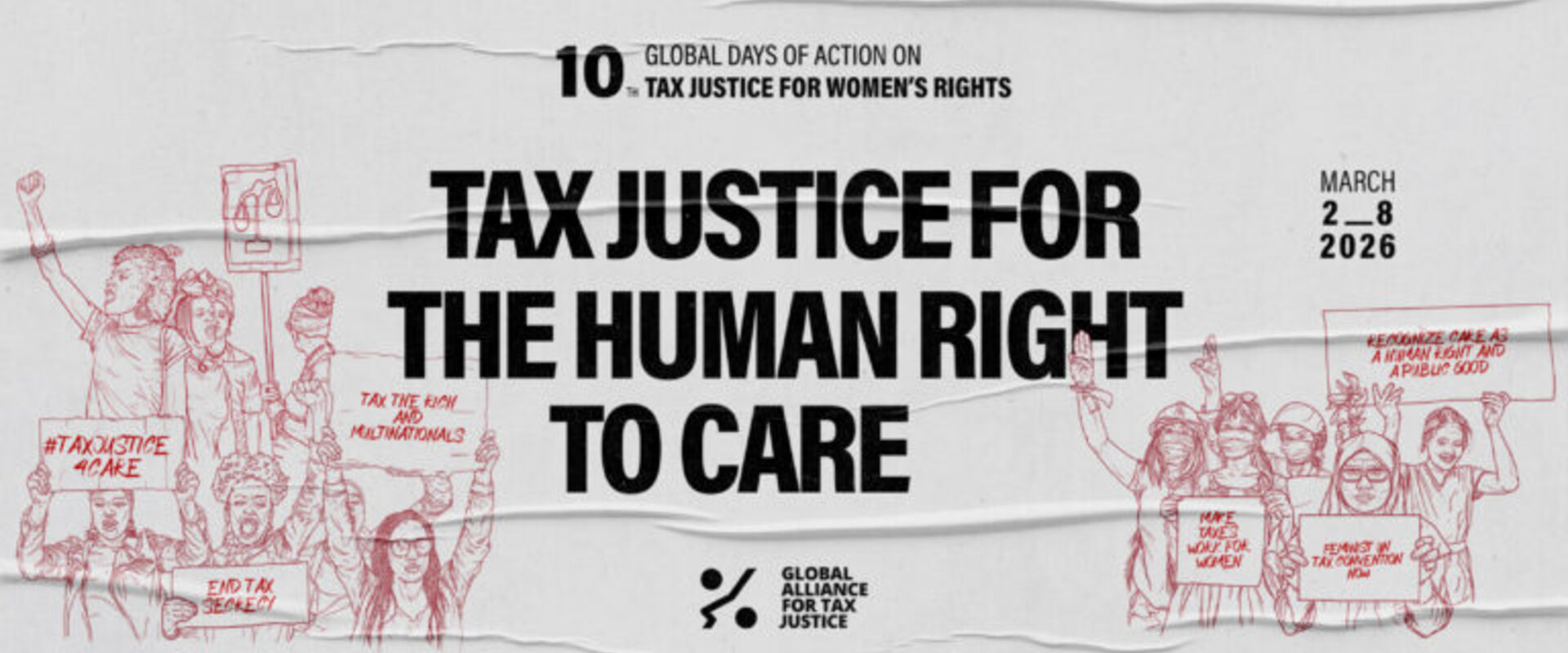
Tax justice for the human right to care!
There is no gender equality without strong public care systems, and there are no strong public care systems without fair and progressive taxation.
Read moreAbout the campaign
The global social organization of care crisis is one of the most urgent yet least addressed dimensions of gender inequality. Globally, women and girls shoulder the heaviest burden of unpaid and underpaid care work through sustaining households, communities, and economies while absorbing the failures of underfunded public systems such as health and education. A feminist analysis of this crisis shows us that it is not accidental. It is the outcome of tax and fiscal systems that systematically undervalue social reproduction, privatise risk, and prioritise capital over people. Under these conditions, care is systematically erased from economic policy and treated as a responsibility of women rather than a public good. As states disinvest in care infrastructure, social protection and services, care is commodified with women positioned as shock absorbers of economic crises, stretching their time, labour and bodies to compensate for shrinking public services. Further magnifying and complicating the problem is, Global South women being exported to Global North countries to address their respective care crisis, often subjected to modern slavery and exploitative working conditions. The care crisis is inseparable from the climate crisis. Without adequate public revenues, states cannot build resilient infrastructure or guarantee social protection systems capable of responding to climate shocks.
The global tax system has a significant role in perpetuating this crisis. Current international tax rules enable multinational corporations (MNCs) and High Net Worth Individuals (HNWIs) to avoid and evade taxation at a massive scale, depriving states—particularly in the Global South—of the public revenues required to fund universal, quality, and gender-responsive public services. At the same time, many countries face escalating debt service obligations that further restrict fiscal space. Governments often compensate for these losses through regressive consumption taxes, austerity measures, and cuts to public services, all of which disproportionately harm women, deepen poverty, and entrench gendered inequalities.
The care crisis is also a crisis of countries’ inequality and not separate from global economic governance. The same inequalities between countries and power imbalances that push women from lower-income countries into transnational care work are mirrored in international tax rules that strip those countries of the revenues needed to fund domestic care systems.
For decades, international tax rules have entrenched structural imbalances between source countries, predominantly in the Global South, and residence countries in the Global North. Regions such as Africa and Asia, which while classified as net importers in actual practice, export a lot of natural resources and cheap labour, systematically losing taxing rights through restrictive tax treaties and profit-shifting practices which are biased towards the Global North countries and disadvantageous to countries in the Global South. In practice, unfair tax rules shift money to wealthy countries where corporations are based (residence countries), while countries where people work and resources are extracted (source countries) are left underfunded. The result is a care crisis in which women make up the gap with unpaid labour. This imbalance is particularly visible in extractive sectors, where profits are often shifted abroad while environmental damage and social reproduction costs remain local.
The ongoing negotiations toward a United Nations Framework Convention on International Tax Cooperation (UN Tax Convention) represent a historic opportunity to reshape the global tax architecture. Success would mean enforceable commitments on transparency, fair allocation of taxing rights, and mechanisms that genuinely expand fiscal space in developing countries. However, the current Draft Framework Convention Template falls short of delivering an inclusive, equitable, and rights-based system capable of addressing structural inequalities—particularly those rooted in gendered divisions of labour and care.