International Women's Day Strengthening Care Economy and Gender Pay Equity in Public Sector
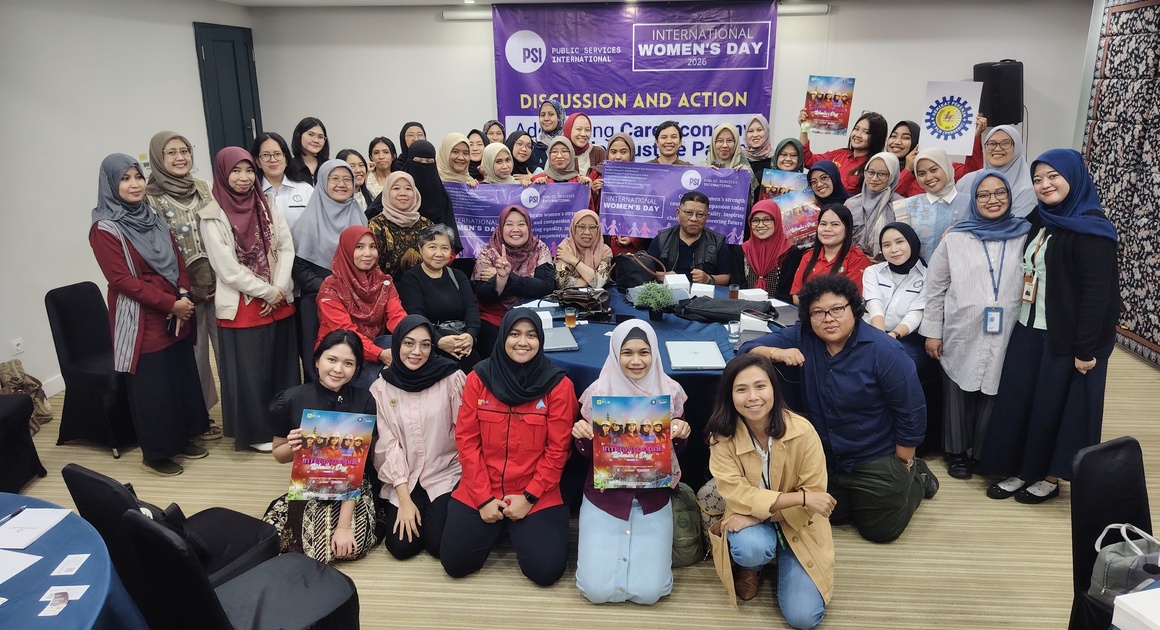
At an IWD meeting in Jakarta, PSI and Indonesian unions discussed gender pay equity and the care economy, highlighting structural inequalities and outlining union-led strategies to advance justice for women workers.
- Read this in:
- en

Indah Budiarti
For PSI and its affiliates in Indonesia, International Women’s Day (IWD) is not merely a moment of commemoration but part of a long-standing movement rooted in the labour struggle. This movement is not only about economic rights, but also about dignity, justice, and a decent life for all workers. While important progress has been made over the years, significant challenges remain due to structural inequalities, corporate interests, and policy environments that often fail to protect workers adequately.
Despite rapid economic development, labour exploitation continues. Women workers experience this exploitation on two levels simultaneously: as wage labourers in the workplace and as providers of unpaid care work in the household.
Even in the public sector and state-owned enterprises, Indonesia continues to face a significant gender wage gap. Women earn on average about 23 percent less than men for work of equal value. At the same time, women’s economic participation has increased only marginally. Deeply rooted social norms continue to position women as primary caregivers and men as breadwinners. Workplace policies rarely accommodate these realities, leaving women to balance paid work with disproportionate caregiving responsibilities.
Against this backdrop, PSI and its seven affiliates in Indonesia organised a meeting on March 9, 2026, titled “Addressing the Care Economy for Gender Pay Justice in the Public Sector.” The meeting, held in Jakarta, brought together union leaders and activists to discuss gender inequality in the workplace and develop concrete advocacy strategies.
The meeting featured Kate Lappin, Regional Secretary of PSI Asia Pacific, as the keynote speaker. She was joined by Herni Ramdlaningrum, Gender and Inclusive Development Specialist and Deputy Director of the SRI Institute. The discussion was moderated by Evi Krisnawati, General Chairperson of FSP FARKES Reformasi and Female Representative of PSI NCC Indonesia.
Kate Lappin, Regional Secretary, PSI Asia Pacific
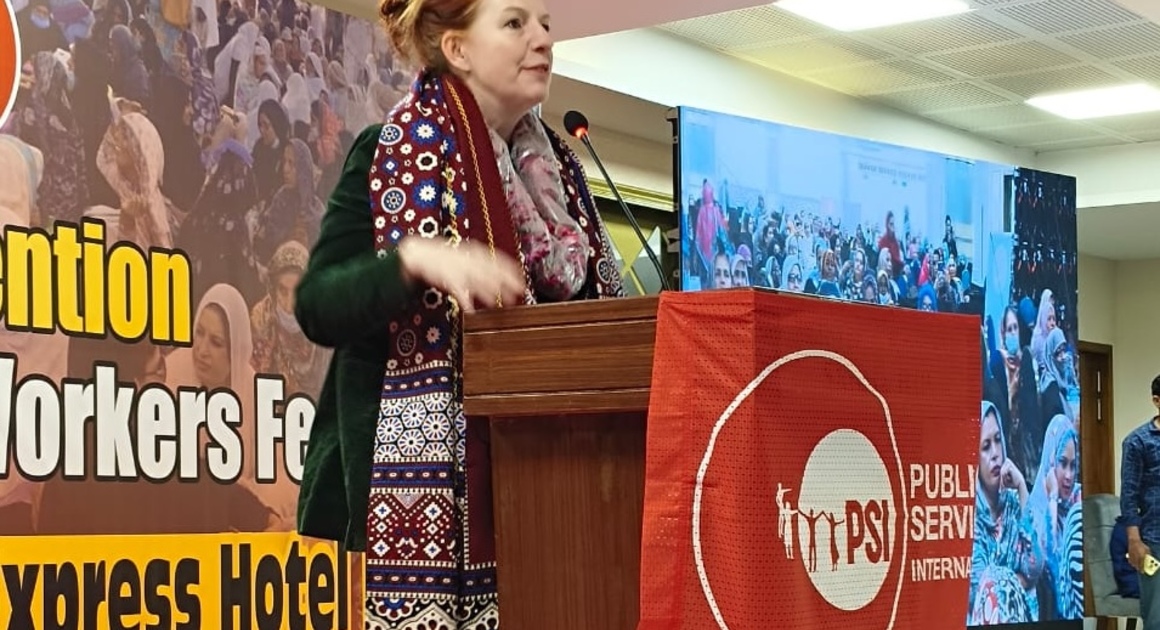
The trade union movement is fundamentally a caring movement. We fight for the well-being of others, even those we don’t know
Care work and gender inequality
The discussion centred on three interconnected issues: gender wage inequality, recognition of the care economy, and structural barriers faced by women workers in public services.
These issues are particularly visible in sectors such as health, education, and social services, where women make up a large share of the workforce. Women workers often find themselves in a paradoxical position: their labour is essential for the functioning of society, yet their work is frequently undervalued, underpaid, and associated with limited career opportunities.
In her presentation, Kate Lappin emphasised the central role of the care economy in sustaining social and economic life. However, much of this work—often performed by women—remains poorly recognised.
“The trade union movement is fundamentally a caring movement. We fight for the well-being of others, even those we don’t know,” Kate said. For her, defending the care sector is not only about advancing women’s rights but also about building a more just society.
She stressed that unions must play a stronger role in demanding fair recognition and compensation for care work. Despite its importance, care work often faces wage inequality, limited recognition, and restricted access for women to leadership positions.
Gender equality within unions
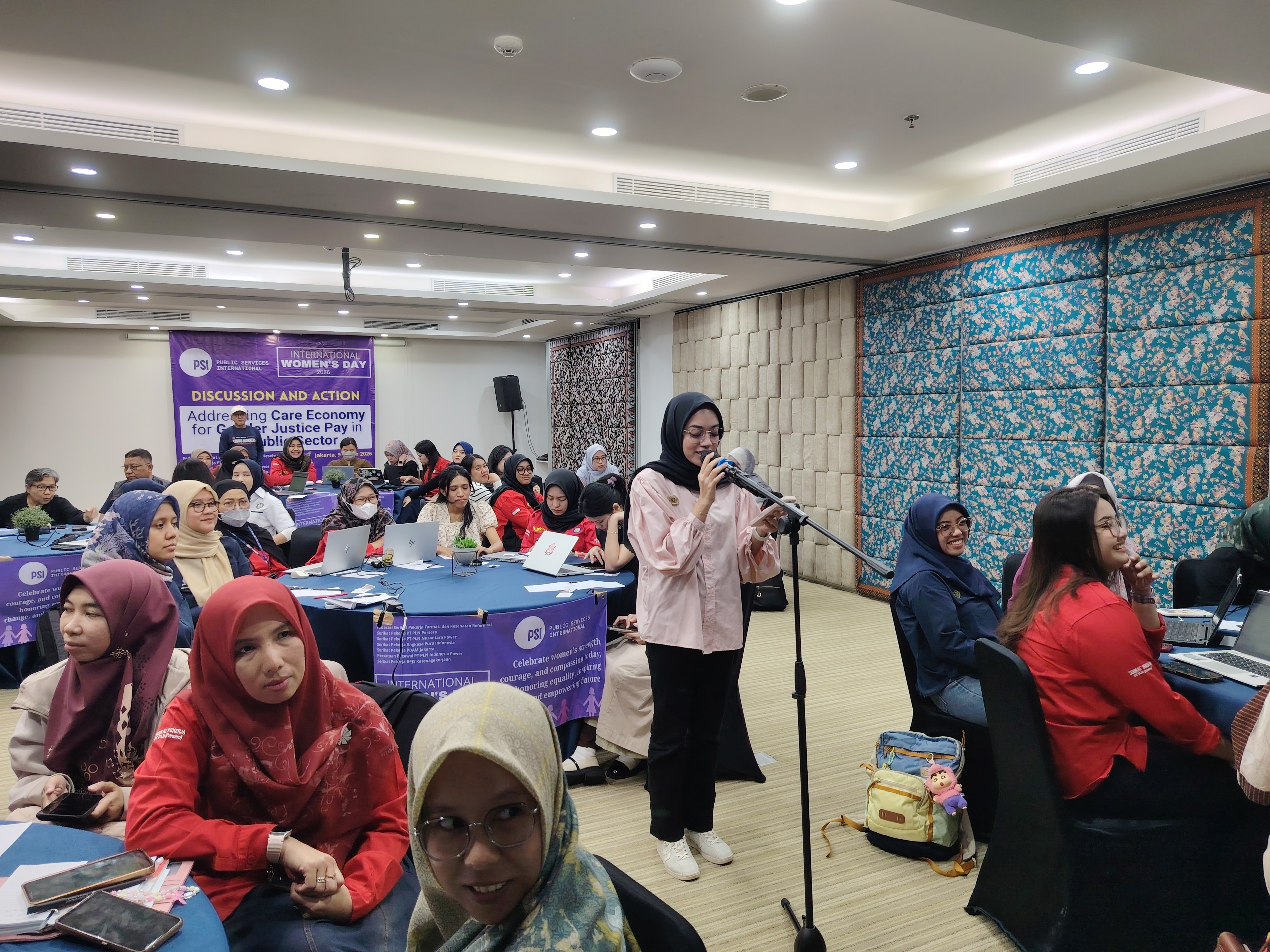
Participants also raised questions about how unions themselves can prioritise gender equality.
Irma Rahmawati from the PLN union asked how unions can promote equal pay and recognition of women’s work when leadership structures remain largely male dominated. She questioned how male union members could be encouraged to treat gender equality as a core issue.
Kate acknowledged that making gender equality a priority within unions is challenging, given their historical roots in male-dominated labour structures. However, she emphasised that wage inequality ultimately harms all workers.
“If women can be paid less, employers will resist raising men’s wages as well. Raising women’s wages benefits all workers,” she said.
For Kate, equal pay is therefore not only a women’s issue but a class issue. Dialogue with male union members is essential so they understand that improving women workers’ conditions strengthens the position of the entire workforce.
She also highlighted the importance of expanding women’s leadership within unions and encouraging greater involvement of young workers, who often bring stronger commitments to gender equality.
“Unions will not survive without younger generations. When young workers recognise that gender equality is in their interest, unions must take that seriously,” she said. However, she emphasised that these changes depend on strong worker organising and collective power.
Wage transparency and structural barriers
Another issue raised during the discussion was the lack of transparency in wage systems. Agus Naini Siregar from the PLN union noted that workers often do not know how wages are determined, creating space for discrimination and unfair practices.
Kate emphasised that transparency is essential for fair industrial relations. Unions must have access to information about wage structures to ensure equality. She cited Australia’s “right of entry” system, which allows union officials to inspect company documents related to wage payments.
“Without wage transparency, workers are extremely vulnerable to exploitation because no one can verify whether they are receiving their rightful entitlements,” she explained.
She also connected wage inequality with broader structural barriers such as the glass ceiling, which limits women’s access to leadership positions. Policies that allow men and women to share caregiving responsibilities—such as parental leave—are therefore essential.
Herni Ramdlaningrum Deputy Director, SRI Institute
“When care work is monetised, it is often undervalued simply because it is seen as women’s work, which is akin to wage penalty.
Recognising the value of care work
Following Kate’s presentation, Herni Ramdlaningrum took the discussion forward by focusing on the care economy and linking it to the IWD 2026 theme “Rights, Justice, and Action.”
Care work includes everyday activities that sustain life—such as childcare, cooking, cleaning, caring for the sick, and supporting elderly family members. Although traditionally framed as women’s responsibilities, these activities represent major economic contributions.
Based on time-use surveys conducted in East Nusa Tenggara (NTT) and West Nusa Tenggara (NTB), Herni explained that if women’s unpaid care work were monetised, its value could equal three times the minimum wage earned by their husbands.
“When care work is monetised, it is often undervalued simply because it is seen as women’s work,” she said, referring to this as a “wage penalty.” She also described unpaid care work as an “invisible subsidy” supporting the formal economy, as many men are able to work full-time because women perform unpaid labour at home.
Towards concrete policy change
Herni proposed using the ILO’s 5R framework as a policy guide for addressing care work:
Recognise care work
Reward care workers fairly
Reduce the burden of unpaid care work
Redistribute care responsibilities more equally
Represent care workers in decision-making
She emphasised the need for public and private investment in care infrastructure, including childcare services, maternity protection, paternity leave, lactation facilities, and social protection for care workers. For trade unions, these issues can be advanced through collective bargaining agreements, workplace policies, and public advocacy.
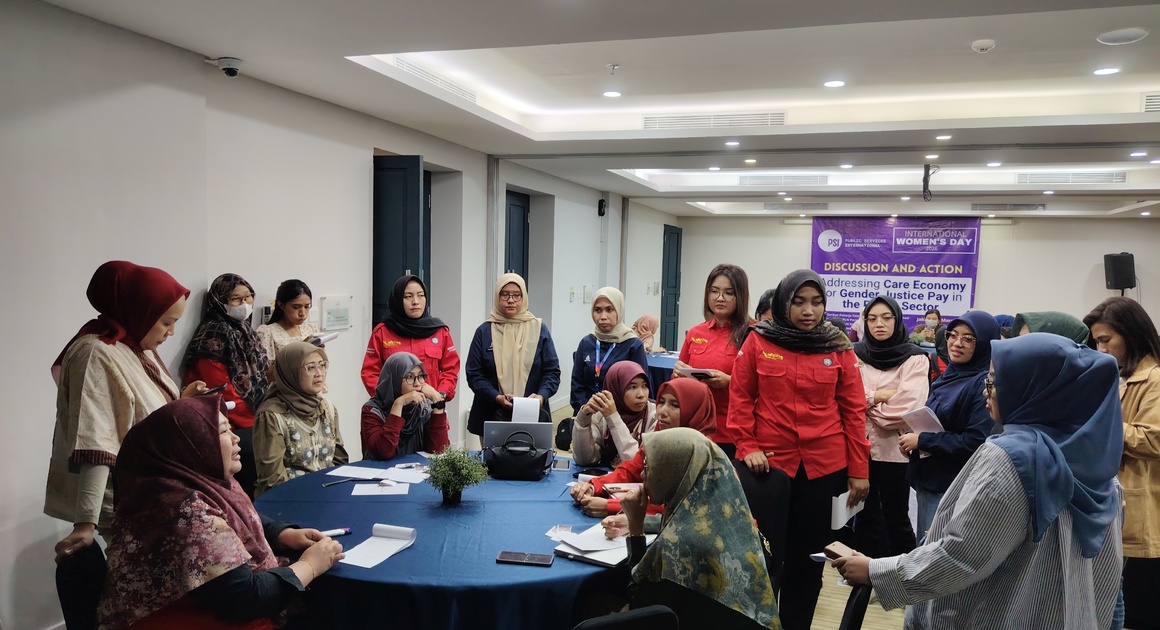
In the final session, participants developed concrete advocacy recommendations. One group focused on promoting equal pay for equal work, calling for stronger enforcement of anti-discrimination laws and greater wage transparency. Another group emphasised the need to integrate care economy issues into company policies and national labour regulations, including support for workers with family care responsibilities.
A long struggle ahead
The discussions highlighted that achieving gender equity in the workplace requires sustained organising, strong alliances, and political commitment. Herni concluded with a stark warning: “If we do not take real corrective steps today, gender equality may not be achieved for another 300 years.”
Her message underscored the urgency of action. Gender justice will not emerge automatically—it must be fought for.
Closing the meeting, Indah Budiarti from PSI and Evi Krisnawati, women’s representative of PSI NCC Indonesia, emphasised that the recommendations from the meeting would form part of a concrete advocacy agenda for PSI affiliates in Indonesia.
These efforts aim to strengthen the bargaining power of trade unions in advancing gender equality in wages and recognition of the care economy. PSI reaffirmed its commitment to supporting unions in turning these discussions into real policy changes and workplace practices.